
•
5 mins

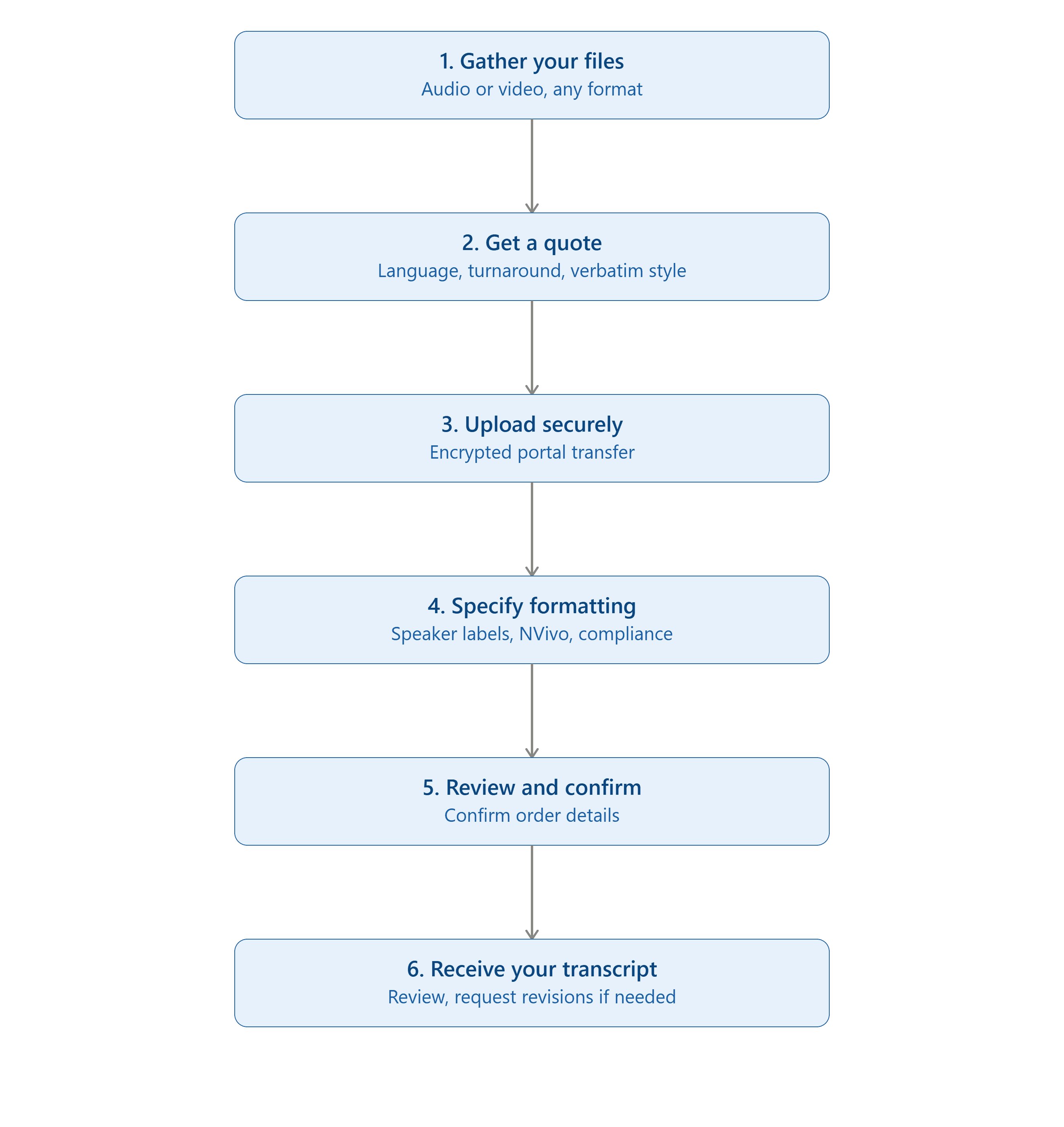
Ordering transcription services comes down to six steps: gather your files, get a quote, upload securely, specify formatting and compliance needs, review and confirm the order, then receive and review your transcript. Most delays and revision requests trace back to skipping step four, deciding on formatting after the fact instead of before transcription starts.
Step 1: Gather Your Files
Before you order anything, get your recordings organized. Both audio and video are accepted, so you don't need to extract audio from a video file first. Check that each file plays back cleanly, and note the total length, since pricing is calculated per recorded minute. If you have multiple sessions, like several interviews or focus groups for the same project, keep them named consistently now. It saves confusion later when transcripts start coming back and need to be matched to the right source file.
Step 2: Get a Quote
This is the step worth slowing down for, since the decisions you make here shape everything downstream. Figure out your language needs first: standard English transcription runs $1.20 per minute. Other languages are priced individually, Spanish and Japanese both have their own per-minute rates for transcription and for direct translation into English. Decide on turnaround next, standard delivery is more affordable than rush, so it's worth requesting rush only when you genuinely need it. And decide on verbatim style now rather than later: clean verbatim removes filler words for readability, full verbatim preserves every "um" and false start for linguistic or behavioral analysis. Changing your mind after transcription is complete usually means paying to have it redone.
Step 3: Upload Securely
Once you know what you're ordering, upload your files through an encrypted portal rather than emailing recordings as attachments or dropping them into an open file-sharing link. This matters even more if your project involves identifiable participant data, health information, or anything covered by confidentiality requirements. A secure upload step protects the file from the moment it leaves your hands, not just after it arrives.
Step 4: Specify Formatting and Compliance Needs
This is the step people skip most often, and the one that causes the most rework when it's skipped. Decide on speaker labeling conventions before transcription starts, "Interviewer" and "Participant 1," or "Moderator" and "Respondent A" through "F" for a focus group, and keep that convention consistent across every file in the project. If your transcript needs to import cleanly into NVivo, ATLAS.ti, or MAXQDA, say so now, since each has its own formatting quirks that are far easier to build in from the start than to fix after delivery. If your research involves human subjects, flag any HIPAA, GDPR, PIPEDA, or IRB-related requirements at this stage too, including whether de-identification needs to happen before or after transcription.
Step 5: Review and Confirm
Before the order goes through, double-check everything you specified: language, turnaround, verbatim style, formatting, and any compliance requirements. This is the last easy point to catch a mismatch, changing a decision after the order is confirmed and work has started is far more disruptive than catching it now.
Step 6: Receive and Review Your Transcript
When your transcript arrives, don't file it away unread. Spot-check it against the original recording while the audio is still fresh in your memory, this is when errors are easiest to catch and cheapest to fix. If something's off, a misheard technical term, an inconsistent speaker label, flag it right away. A good revision process should be fast and shouldn't require you to justify a genuine transcription error.
Ready to order? Get started here.
FAQ
How long does the whole process take from upload to delivery? Standard turnaround typically runs a few business days depending on audio length and language. Rush options are available for tighter deadlines, usually at a higher per-minute rate.
Can I change my verbatim style after ordering? It's possible, but it usually means redoing some or all of the transcription work, since clean and full verbatim require different handling from the start. Deciding upfront saves both time and cost.
Do I need to specify NVivo formatting, or is it automatic? It's worth specifying explicitly, since different qualitative analysis tools expect slightly different structures. Flagging this at the quote stage means the transcript arrives ready to import rather than needing reformatting.
What if my project involves multiple languages in one session? Flag this at the quote stage. Bilingual sessions, where a moderator and participants speak different languages, need to be handled as a single coordinated order rather than split into separate transcription and translation steps after the fact.
What happens if I find an error after delivery? Flag it as soon as you spot it, ideally while reviewing the transcript against the original recording. Genuine transcription errors should be corrected without a lengthy back-and-forth.
Related Reading
Turn your recordings into analysis-ready transcripts.
Human Transcription
Clean verbatim and full verbatim transcripts, delivered by specialist transcriptionists
AI Transcription
Instant Draft powered by AI, with Smart Insights for analysis-ready output
Translation Services
Accurate translation across 99+ languages for multilingual research workflows
Keep reading
Related articles

How to Write a Transcription Data Management Plan for IRB Submission
Most IRB protocols get sent back for revision on the data security and management sections, and within those sections, transcription is the specific area where protocols most frequently fall short. The reasons are consistent: researchers describe their interview methodology in careful detail, specify their analysis software, and then write a single sentence about transcription that doesn't address who's doing it, what compliance standards the vendor meets, how files will be transferred, where they'll be stored, or when they'll be deleted.
Read article

Spanish Transcription for US Hispanic Research: Dialects, Generations, and What to Expect
A common setup in community-based Latino health research: bilingual interviews with first, second, and 1.5-generation participants, conducted in English or Spanish depending on each participant's preference, at community organizations across a Midwestern city. The recordings come back mixed. Some are fully in Spanish, some fully in English, some switching mid-interview as participants reach for the language that fits the concept they're describing. One transcriptionist flags the mixed recordings as too difficult. Another delivers transcripts where heritage speaker constructions have been silently corrected to standard Spanish. The researcher is now reviewing every transcript manually before analysis can begin. This is the predictable result of sending US Hispanic research recordings, whether from one-on-one interviews, focus groups, or Zoom, Teams, and Webex sessions, to transcription services built for standard, monolingual speech.
Read article

The Best Transcription Services for Focus Groups in 2026
Focus groups generate some of the most demanding audio in qualitative research. Six to twelve people talking, sometimes over each other, sometimes in a room with bad acoustics, sometimes over a Zoom call with background noise from a home environment. Getting that audio into a clean, usable transcript is where a lot of research budgets and timelines get tested. Not every transcription service handles this well, and the right one often depends on the kind of focus group you're actually running.
Read article

© 2026 Qualtranscribe LLC. Services Provided Globally