
•
8 mins

Focus group transcription is harder than any other format because getting speaker attribution right across six to twelve simultaneous voices requires human judgment that AI consistently fails at. This guide covers seven human transcription services starting with Qualtranscribe, including two specialists built exclusively for market research, with real pricing, compliance details, and a matching guide for different focus group types.
Why Focus Groups Are Harder to Transcribe
A two-person interview is relatively straightforward: one person speaks, the other responds, and speaker changes are usually clear. Focus groups are different in ways that matter for research quality.
Multiple speakers with similar voices. The more people involved, the harder it becomes to maintain accurate speaker attribution throughout a session. Participants can have similar voices, speak from different distances from the microphone, or move around during an in-person session. A human transcriptionist can use the context of the conversation, speaker patterns, and the recording itself to resolve ambiguities that automated diarization mishandles.
Overlapping speech. A participant may begin answering while another person is still speaking. Someone else may respond with a short comment. The moderator may redirect the conversation while participants continue talking. A transcript that silently drops one of these voices or assigns it to the wrong speaker corrupts the speaker attribution data for everything that follows.
Informal, conversational speech. Focus groups are conversational by nature. Participants use slang, incomplete sentences, fillers, repetitions, local expressions, and industry-specific terminology. Whether these elements should remain in the transcript depends on the research methodology, but a transcriptionist needs to recognize them accurately before that decision can be made.
Background noise and variable audio quality. In-person sessions include room noise, chairs, air conditioning, and participants speaking away from the microphone. Online sessions add inconsistent microphone quality, background noise from home environments, and connection issues that create gaps or garbled audio.
Human vs AI for Focus Group Transcription
AI transcription has become genuinely useful for producing fast first-pass drafts. For final focus group transcripts, the picture is more complicated.
Consideration | Human Transcription | AI Transcription |
|---|---|---|
Clear one-to-one interviews | Strong | Good |
Multiple speakers | Strong | Variable |
Heavy crosstalk | Human judgment | Can be challenging |
Similar-sounding voices | Contextual review | Can misattribute speakers |
Regional accents | Contextual interpretation | Performance varies |
Noisy recordings | Human review | Performance degrades |
Speaker labels | Manually verified | Automated diarization |
Research terminology | Contextual review | May require correction |
Unclear speech | Flagged and reviewed | May be incorrectly guessed |
Final research transcript | Suitable as delivered | Always requires review |
AI can be useful when speed is the priority or when a researcher needs a preliminary draft before formal coding begins. For final focus group transcripts where speaker attribution will be cited in analysis and reporting, human transcription is the appropriate standard.
What a Research-Ready Focus Group Transcript Looks Like
Before comparing services, it helps to be clear about what you're actually looking for. A research-ready transcript does more than capture words. It preserves the structure of the discussion.
The key is consistency. Researchers should be able to move through the transcript without wondering who is speaking. Depending on the project, you may also need timestamps, participant IDs, overlapping speech markers, de-identification, and formatting compatible with NVivo, ATLAS.ti, or MAXQDA.
The Seven Services
1. Qualtranscribe: Best Overall for Focus Groups Across Every Format
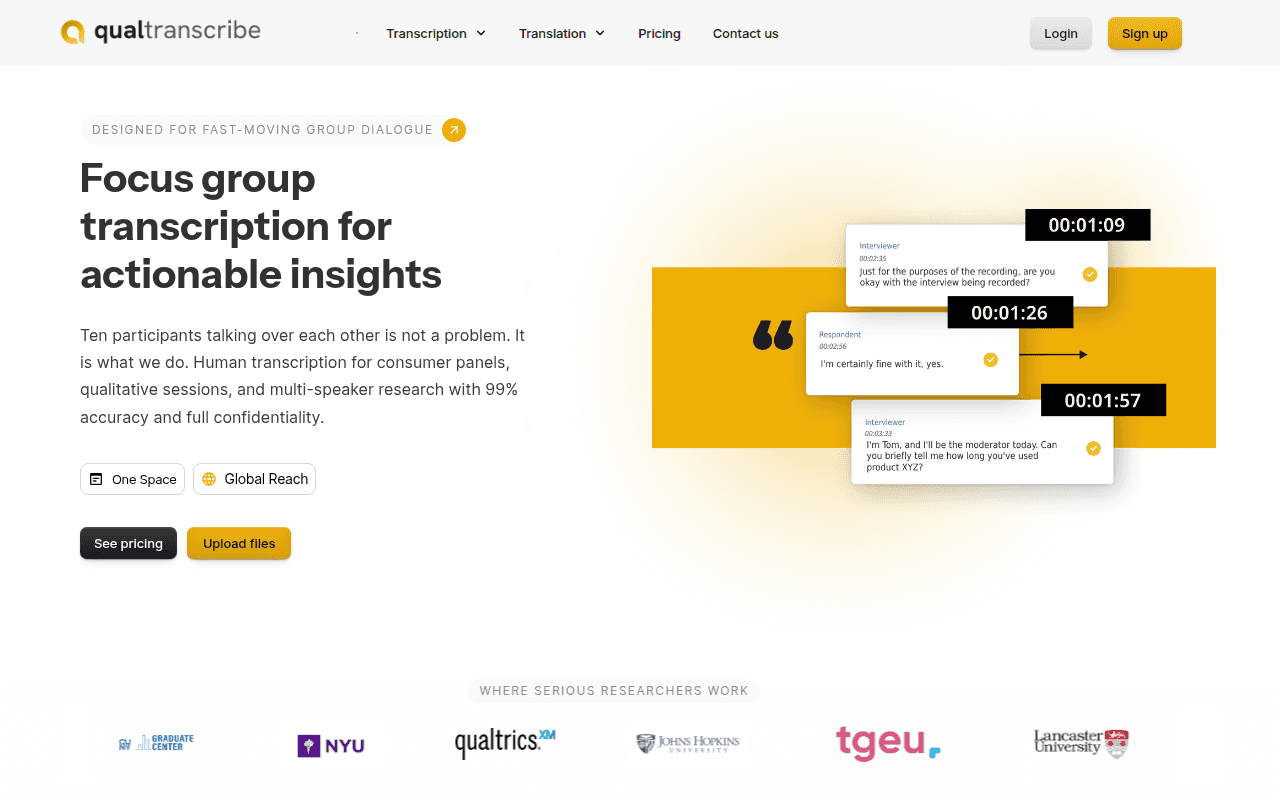
Qualtranscribe is built specifically around multi-speaker, verbatim transcription for focus groups across in-person, Zoom, Teams, Webex, and hybrid formats. Every transcript clearly distinguishes moderator from respondents, holds up through crosstalk and overlapping speech, and is available in either clean verbatim or full verbatim. Speaker labels, timestamps, and formatting compatible with NVivo and ATLAS.ti come standard with no reformatting step before coding starts. HIPAA, GDPR, PIPEDA, and APPI compliance apply across every project, with de-identification available wherever a study requires it.
Moderator and participants can be transcribed in different languages within the same session, with speaker labeling preserved throughout. Direct translation delivers an English transcript in one pass rather than a separate transcribe-then-translate step.
Pricing: $1.20/min standard English human transcription. Other languages from $2.50/min transcription, $6.00/min direct translation into English.
Languages: 25+ human, 99+ AI via Instant Draft.
Compliance: HIPAA, GDPR, PIPEDA, APPI. Recordings never used for AI training.
Best for: Qualitative researchers, market research agencies, and clinical teams running in-person, online, or hybrid focus groups across multiple markets and languages, with academic IRB workflows, multilingual transcription & translation.
2. Babbletype: Best for Market Research Specialization
Babbletype has worked exclusively in market research transcription for over 20 years, with more than 10 million minutes of audio transcribed. Every transcript is done by a human with no AI drafting step and no offshore subcontracting. Its tiered product structure sets it apart for focus groups: PureText for standard clean verbatim, PureResponse for summarized moderator questions with full respondent verbatim, and master transcripts that consolidate every respondent's answer to each discussion guide question across an entire multi-session study.
Pricing: Quote-based for English. $4.25/min for foreign-language interviews delivered as English transcripts.
Turnaround: 2 days standard, a flat commitment rather than a variable range.
Compliance: No public certifications listed. Confidentiality handled through in-house, US-based, human-only staffing.
Best for: Market research firms running recurring English-language studies who want a dedicated market research specialist with a flat 2-day turnaround commitment.
3. Focus Forward: Best for Facility-Integrated Transcription
Focus Forward has served market research since 2003, offering nationwide qualitative recruitment, transcription, open-end coding, and incentive processing as one connected service. Its transcription is offered directly at many leading US focus group facilities, so if you're booking a facility for an in-person session, Focus Forward may already be available on-site.
Pricing: Quote-based.
Options: Human and AI depending on project needs.
Languages: Translation in 100+ languages.
Best for: Researchers who want transcription bundled with recruitment and facility logistics.
4. TranscribeMe: Best for Budget-Conscious Projects
TranscribeMe has operated since 2011 with a large transcriptionist network serving market research, academic, legal, and medical sectors. Its tiered pricing structure gives flexibility across a large project without committing to a single rate.
Pricing: Human transcription from $0.79/min base. Full verbatim $1.75/min ($0.79 base + $0.96 verbatim add-on). Timestamps and speaker IDs add $0.25/min. Fully loaded approximately $2.00/min.
Turnaround: Tiered from same-day rush to a few business days.
Compliance: HIPAA requires pre-registration and dedicated workflow setup. GDPR compliant.
Best for: High-volume, budget-conscious projects willing to trade some turnaround speed for lower per-minute cost.
5. Rev: Best for Speed
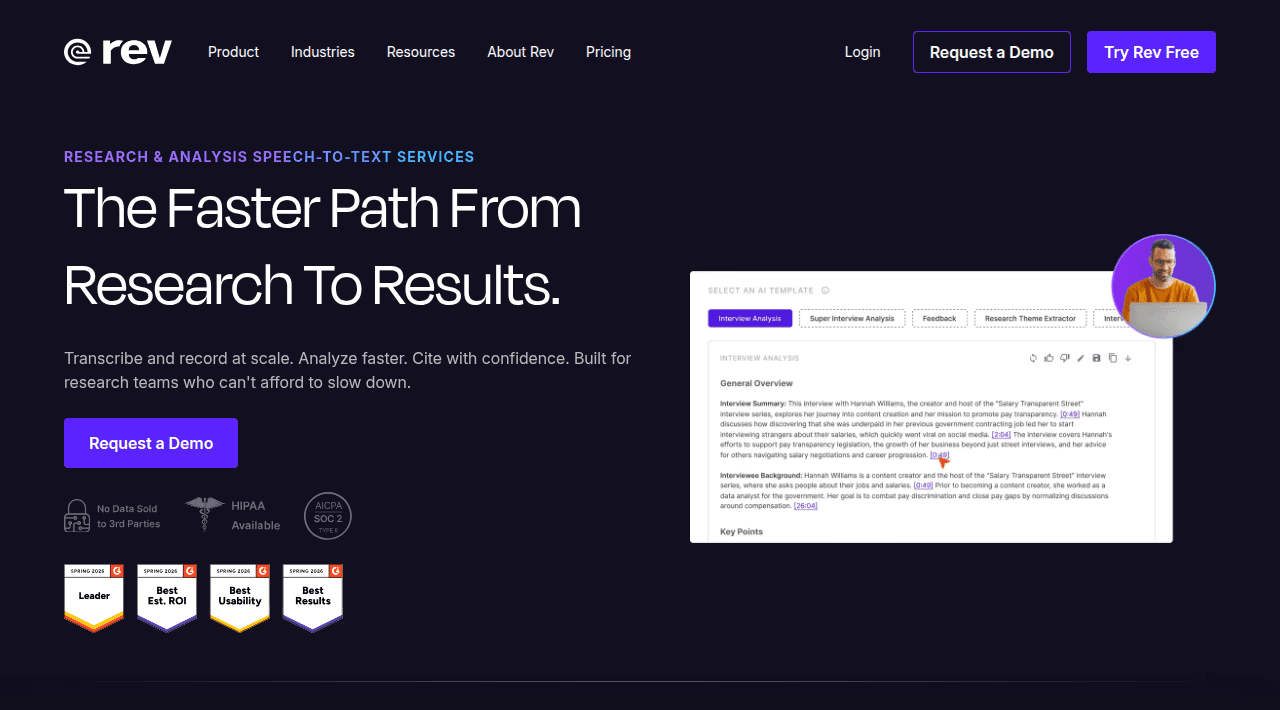
Rev offers human transcription with multiple turnaround tiers. Diarization performs well with clearly distinct, non-overlapping voices, but for focus groups with similar-sounding speakers or heavy crosstalk, Rev recommends a manual verification pass before using automated speaker labels in a final deliverable.
Pricing: $1.99/min standard (12-hour turnaround). $2.49/min full verbatim. $1.75/min 5-hour rush. $2.50/min 1-hour rush.
Compliance: SOC 2 Type II. HIPAA for enterprise clients. GDPR compliant.
Worth knowing: Rev's Terms of Service updated September 2023 grant Rev perpetual rights to use uploaded audio to train its proprietary AI by default. Opt-out requires emailing their support team explicitly.
Best for: Projects where turnaround speed is the primary criterion.
6. GoTranscript: Best for High-Volume Market Research
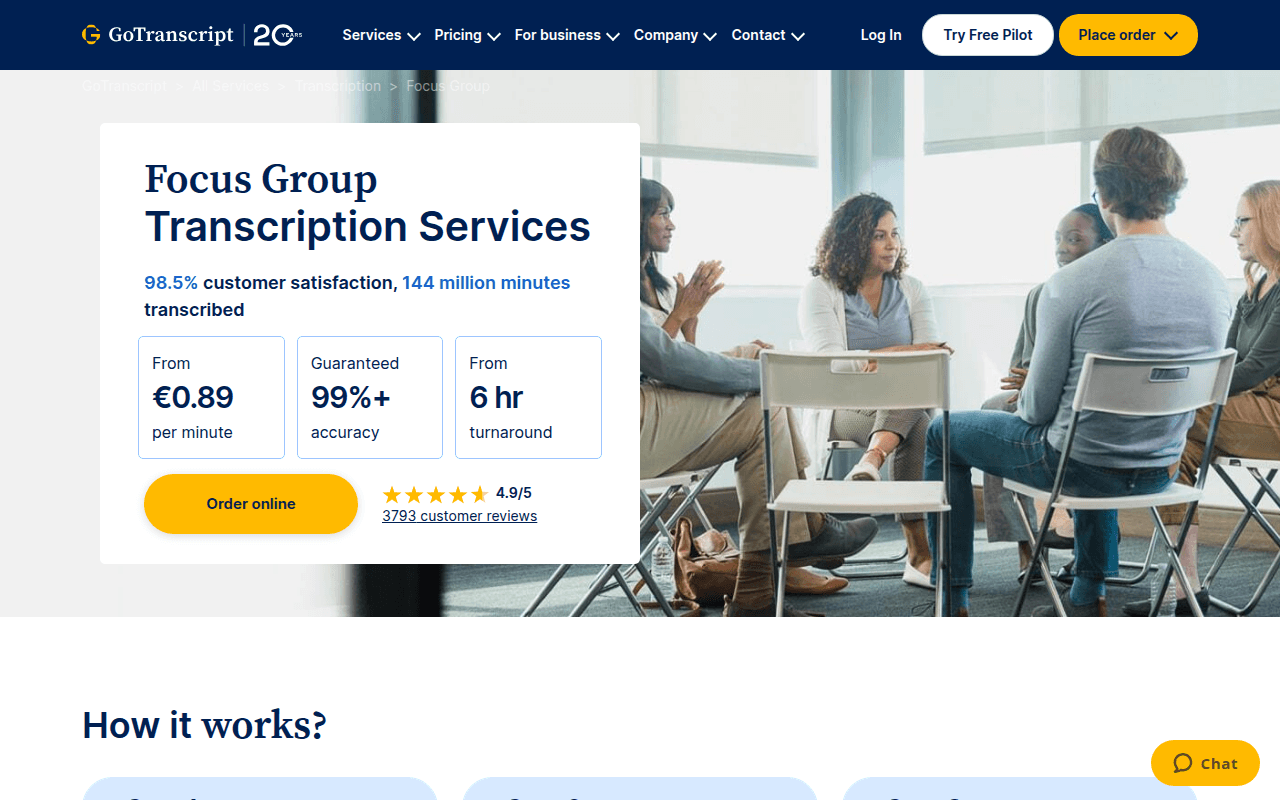
GoTranscript states it has transcribed over 900,000 minutes of market research interviews, focus groups, and surveys, and claims to be trusted by more than 120 market research firms. These figures come from the company itself rather than an independent source.
Pricing: $1.20/min English human transcription.
Compliance: States adherence to HIPAA guidelines, PII protection protocols, and NDAs with its transcriptionist workforce.
Best for: High-volume market research projects where scale and accent handling are the priority. Verify claims directly before committing.
7. GMR Transcription: Best for US-Based Human-Only Work
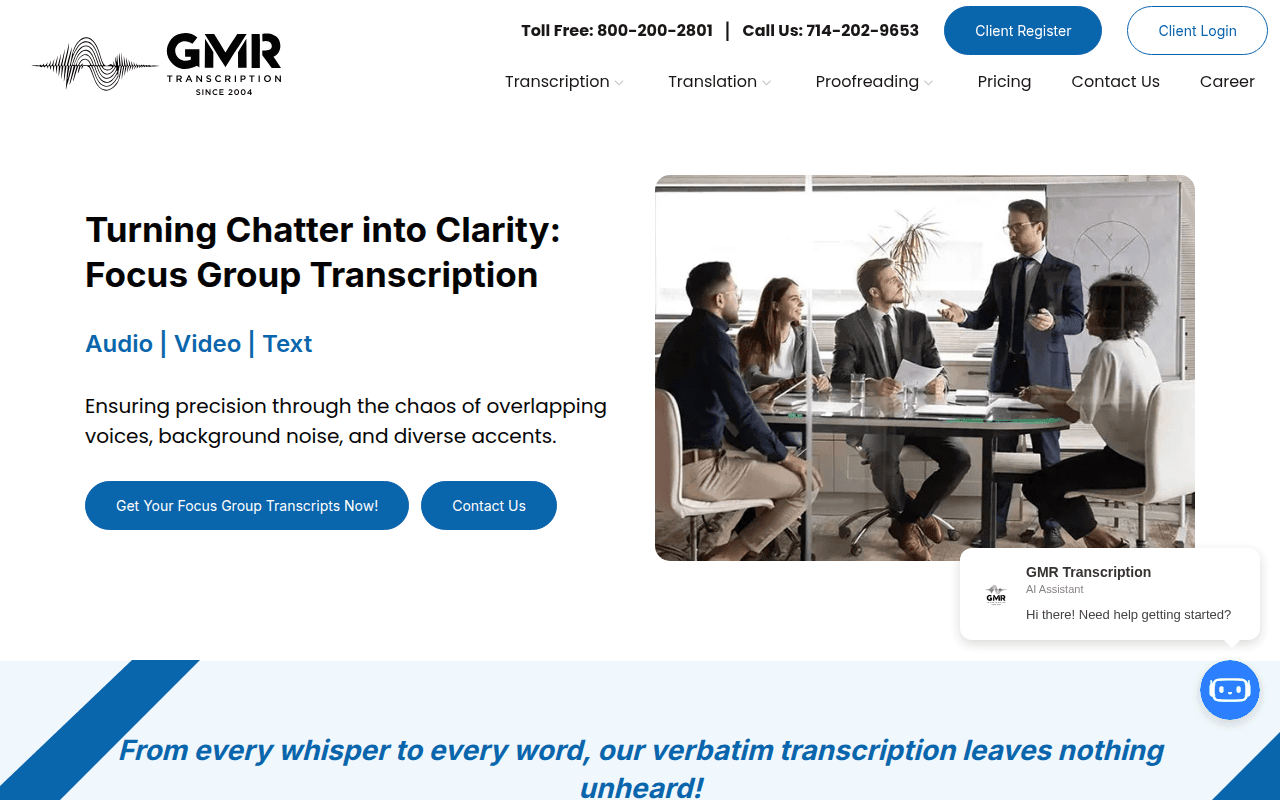
GMR Transcription is a California-based, human-only provider with no automated software in the workflow and US-based transcribers throughout.
Pricing: $1.25/min for 1-2 speakers with clear English audio. Rates increase with additional speakers.
Compliance: HIPAA compliant with BAA available. Secure file transfer portal.
Best for: US-based researchers who specifically need domestic, human-only transcriptionists with HIPAA compliance.
Matching the Provider to the Focus Group
Researchers and agencies who need accurate human transcripts across any focus group format, language, volume, or compliance requirement: Qualtranscribe is built for exactly this, with fast turnaround, IRB and HIPAA coverage, and multilingual capability under one service.
Recurring English-language market research studies where turnaround is non-negotiable: Babbletype specializes exclusively in market research with a flat two-day delivery commitment.
In-person sessions at a dedicated facility: Check whether Focus Forward is already available on-site before sourcing a separate vendor.
High-volume projects where budget is the primary constraint: TranscribeMe or GoTranscript offer lower base rates, though test output against your specific audio before committing.
Research teams requiring human-only transcription with no AI at any stage: GMR Transcription uses domestic transcriptionists exclusively throughout.
What to Look for Before You Choose
Before committing to any provider, ask these questions:
Does the provider regularly transcribe focus groups rather than primarily interviews or meetings?
How are multiple speakers identified when voices are similar?
How is overlapping speech handled: flagged, dropped, or assigned to the louder voice?
Are timestamps available and at what interval?
Can you choose between full verbatim and clean verbatim?
Can the provider handle Zoom, Teams, Webex, and in-person recordings?
Can transcripts be formatted for NVivo, ATLAS.ti, or MAXQDA?
How are recordings handled: who has access, where are files stored, when are they deleted? See Qualtranscribe's security framework for an example of what documented data handling looks like.
Are recordings used for any purpose other than transcription?
How to Prepare Your Recording for Better Results
A few steps before submission make a material difference to output quality:
Provide participant information. A list of speaker IDs or participant codes helps the transcriptionist maintain consistent labeling throughout.
Provide a glossary. Product names, technical terms, brand names, acronyms, and any words that may be difficult to identify from audio alone reduce errors significantly.
Specify verbatim style. Full verbatim for linguistic or discourse analysis. Clean verbatim for thematic analysis and client reporting.
Communicate data requirements upfront. If the project involves sensitive data, IRB obligations, de-identification, or specific compliance frameworks, communicate these before submission rather than after delivery.
Need transcripts that handle every focus group format under one compliant workflow? Get started here.
FAQ
Do I need a different service for in-person versus Zoom focus groups? Not necessarily, but confirm your provider has real experience with both. Zoom, Teams, and Webex recordings carry different audio artifacts than a dedicated facility's setup, and a provider used to one may need extra time to handle the other well.
What is the difference between a standard and a master transcript? A standard transcript covers one session. A master transcript consolidates responses from multiple sessions into a single document organized by discussion guide question, useful for multi-market or multi-session studies.
Should I worry about my recordings training a transcription company's AI model? It matters most for sensitive or confidential content. Some companies use uploaded audio to train their own models by default, with opt-out available on request. Check a provider's terms directly rather than assuming. Qualtranscribe does not use recordings for AI training on any plan.
Is human transcription always better than AI for focus groups? For final focus group transcripts, usually yes. Overlapping speech and multiple similar-sounding voices are exactly where automated speaker labeling breaks down. AI is useful for a fast first-pass draft, but human review before the transcript enters analysis is the appropriate standard for research that will be published or cited.
Do these services handle multilingual focus groups? Most support some multilingual work, but scope varies widely. Confirm the specific languages and whether translation is bundled with transcription or billed separately. Qualtranscribe offers human transcription in 25 languages with direct translation in the same order.
What does a fully loaded focus group transcript cost? The advertised per-minute rate is rarely the final cost. Speaker identification, timestamps, full verbatim formatting, rush delivery, and additional languages all add to the base rate. When comparing quotes, ask for the total delivered cost for your specific session length, speaker count, and requirements rather than comparing base rates.
Related Reading
Turn your recordings into analysis-ready transcripts.
Human Transcription
Clean verbatim and full verbatim transcripts, delivered by specialist transcriptionists
AI Transcription
Instant Draft powered by AI, with Smart Insights for analysis-ready output
Translation Services
Accurate translation across 99+ languages for multilingual research workflows
Keep reading
Related articles

How to Write a Transcription Data Management Plan for IRB Submission
Most IRB protocols get sent back for revision on the data security and management sections, and within those sections, transcription is the specific area where protocols most frequently fall short. The reasons are consistent: researchers describe their interview methodology in careful detail, specify their analysis software, and then write a single sentence about transcription that doesn't address who's doing it, what compliance standards the vendor meets, how files will be transferred, where they'll be stored, or when they'll be deleted.
Read article

Spanish Transcription for US Hispanic Research: Dialects, Generations, and What to Expect
A common setup in community-based Latino health research: bilingual interviews with first, second, and 1.5-generation participants, conducted in English or Spanish depending on each participant's preference, at community organizations across a Midwestern city. The recordings come back mixed. Some are fully in Spanish, some fully in English, some switching mid-interview as participants reach for the language that fits the concept they're describing. One transcriptionist flags the mixed recordings as too difficult. Another delivers transcripts where heritage speaker constructions have been silently corrected to standard Spanish. The researcher is now reviewing every transcript manually before analysis can begin. This is the predictable result of sending US Hispanic research recordings, whether from one-on-one interviews, focus groups, or Zoom, Teams, and Webex sessions, to transcription services built for standard, monolingual speech.
Read article
The Best Transcription Services for Focus Groups in 2026
Focus groups generate some of the most demanding audio in qualitative research. Six to twelve people talking, sometimes over each other, sometimes in a room with bad acoustics, sometimes over a Zoom call with background noise from a home environment. Getting that audio into a clean, usable transcript is where a lot of research budgets and timelines get tested. Not every transcription service handles this well, and the right one often depends on the kind of focus group you're actually running.
Read article
© 2026 Qualtranscribe LLC. Services Provided Globally