
•
10 mins
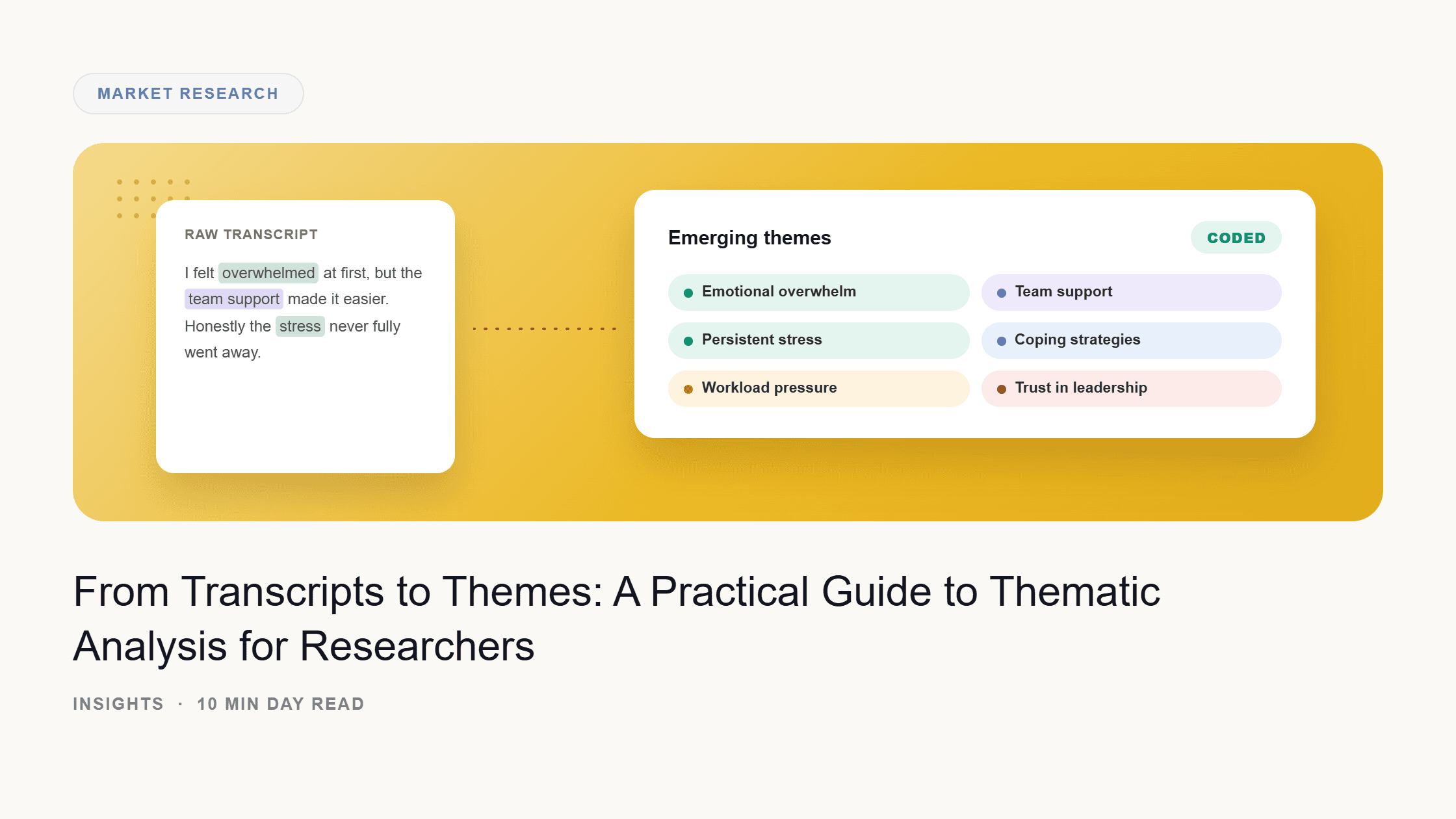
Thematic analysis is the most widely used qualitative analysis method in social science, healthcare research, and market research, and it's the one most frequently done badly. The problem isn't that researchers don't understand the theory. It's that most guides stop short of showing what thematic analysis actually looks like on a real transcript, how to build codes that mean something analytically, how themes differ from topics, and what good write-up looks like. This guide follows Braun and Clarke's reflexive thematic analysis framework, cited over 200,000 times since the original 2006 paper, and applies it to the practical decisions researchers actually face from transcript to findings.
What Thematic Analysis Actually Is
Thematic analysis (TA) is a method for identifying, analyzing, and reporting patterns of meaning across a qualitative dataset. Virginia Braun and Victoria Clarke introduced their six-phase approach in a 2006 paper in Qualitative Research in Psychology, now one of the most cited papers in qualitative methods. They refined it through subsequent publications, culminating in their 2022 book Thematic Analysis: A Practical Guide (SAGE), the most comprehensive current statement of the method they now call reflexive thematic analysis.
What makes reflexive TA distinct is that the researcher is not a neutral coding machine. The themes that emerge are shaped by theoretical positioning, research questions, and interpretive decisions. Acknowledging this and remaining transparent about it is the core requirement of the approach.
Three distinctions to know before coding begins:
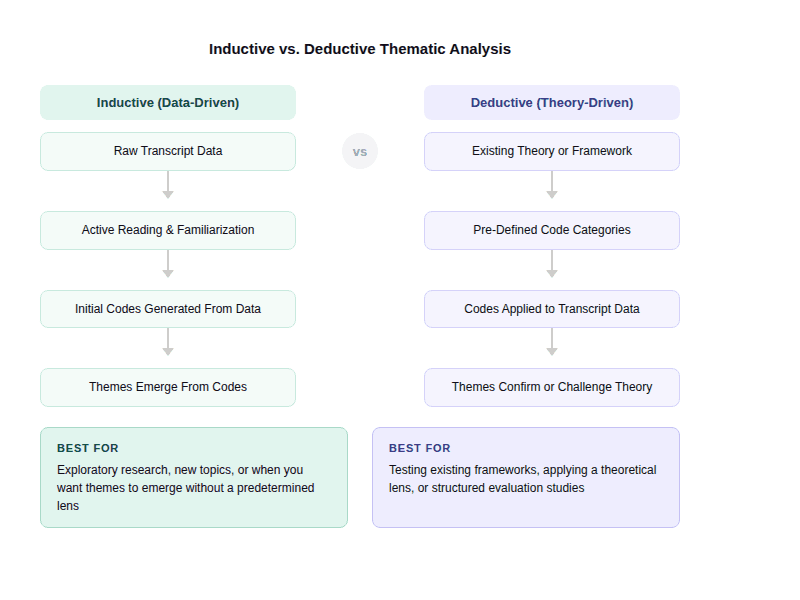
Inductive vs. Deductive:
Inductive TA: Themes emerge from the data without a predetermined framework. Most qualitative research uses a primarily inductive approach.
Deductive TA: Applies an existing theoretical framework to test or apply specific concepts. Used when confirming or extending prior theory.
Semantic vs. Latent coding:
Semantic: Captures explicitly stated meaning. A participant saying "I feel overwhelmed" gets coded under workload stress.
Latent: Examines underlying assumptions and structural causes. More interpretive, and usually where the richest analytical insights live.
Topics vs. Themes:
Topic: A general subject area (e.g., "Workplace Stress")
Theme: An analytical claim about a pattern of meaning (e.g., "Unrealistic Workload as a Systematic Source of Burnout")
Phase 1: Getting Your Transcripts Analysis-Ready
Before writing the first code, transcripts need to be systematically formatted. Qualitative teams routinely underinvest here and pay for it throughout analysis.
Option A: Manual Coding (Small Datasets, 1-5 Short Interviews)
Requirement | Recommended Setup |
|---|---|
Page layout | Double-spaced with wide right margins for handwritten annotations |
Speaker labels | Abbreviated and consistent throughout (MOD:, P1:, P2:) |
Timestamps | Embedded every 2-5 minutes for audio verification |
Non-verbal cues | Standardized bracketed notation: |
File format | Clean PDF or printed physical copies |
Option B: CAQDAS Software (Large Datasets, 6+ Interviews)
Requirement | Recommended Setup |
|---|---|
File type | Clean |
Speaker labels | Identical across every file (never mix "Moderator" and "Interviewer") |
Paragraph breaks | Clear line breaks at every speaker turn for accurate auto-coding |
Naming convention | Structured: |
Qualtranscribe delivers transcripts in NVivo Synchronized, NVivo Headings, NVivo Basic, ATLAS.ti, MAXQDA, and Dedoose-compatible formats as standard, with consistent speaker labeling across every file in a dataset. For NVivo-specific import guidance, see our complete NVivo guide.
Verbatim Style Note: Most thematic analysis uses clean verbatim transcription, removing filler words while preserving meaning. Full verbatim, capturing every "um" and false start, is appropriate for discourse or conversation analysis where how something was said carries analytic weight. Specify your style before transcription begins, not after.
Phase 2: Familiarization and Initial Coding
Familiarization
Familiarization is active immersion, not skimming. Read the entire dataset multiple times before creating a single code. Make informal reflective notes in the margins, but resist formalizing labels too early. Researchers who skip proper familiarization generate codes that miss latent content and produce themes that stay at the surface level.
Generating Strong Analytical Codes
A code is an interpretive observation about a specific data extract, not a summary. Good codes name dynamics and relationships rather than subject areas.
Raw Transcript Extract | Poor / Generic Code | Strong Analytical Code |
|---|---|---|
"I look at the dashboard once a week, but the numbers don't really tell me what to do on Monday morning." | Dashboard usage | Tool-use disconnect; metrics lack actionable utility |
"We were told the policy changed but nobody explained why, so we kept doing what we always did." | Communication failure | Institutional opacity driving behavioral inertia |
"I trust my instincts more than the data at this point, honestly." | Data skepticism | Experiential authority overriding evidence-based practice |
Notice that the strong codes name a relationship or dynamic, not just a subject area. That analytical quality is what makes it possible to build meaningful themes later.
Technique: In Vivo Coding. Uses a participant's exact words as the code label, for example "Numbers don't tell me what to do." This preserves authentic voice and cultural nuance when standard descriptive labels would flatten meaning.
Code the entire dataset systematically before moving to the next phase. Partial coding, covering only the transcripts that seemed interesting during familiarization, produces biased themes.
Phase 3: From Codes to Themes (The Synthesis Gap)
This is the hardest phase and where most thematic analyses fail. The task is to look across all generated codes and identify patterns of shared meaning that cut across the dataset.
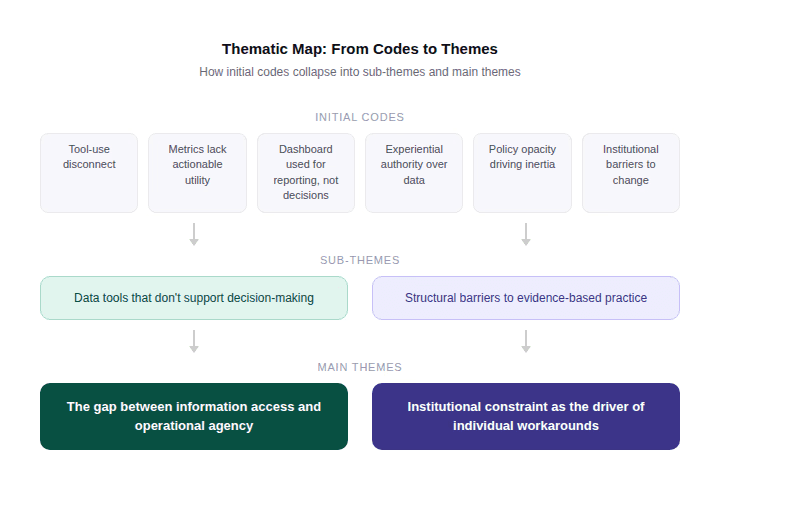
The analytical hierarchy:
Code → Sub-Theme → Main Theme
Code: "Metrics lack actionable utility" (a specific interpretive observation about one extract)
Sub-Theme: "Data tools that fail to support active decision-making" (a pattern grouped across multiple codes)
Main Theme: "The gap between information access and operational agency" (a central organizing concept)
Practical sorting methods:
Physical card sorting: Print each code on an index card. Group related cards on a table, name the relationship between groups, and use that relationship name as the candidate theme.
Matrix tables: Map codes along one axis and participant IDs along the other. This reveals which patterns are widespread across the dataset and which are present in only one or two interviews.
CAQDAS hierarchies: Group nodes hierarchically in NVivo or ATLAS.ti. The software folder structure is organized evidence. The theme is the interpretive claim you make about that structure.
Phase 4: Reviewing and Refining Themes
Braun and Clarke recommend reviewing candidate themes across two levels:
Level 1 (Coded extracts): Do the extracts supporting a candidate theme actually cohere around a central idea? If you can't write a two-sentence definition of the theme, it isn't ready.
Level 2 (Entire dataset): Reread the full dataset against candidate themes. Do they account for subtle contradictions, or do they only work on cherry-picked quotes?
Common theme pitfalls to check:
One-participant themes: A pattern appearing in only one interview is an interesting data point, not a theme
Overlapping boundaries: If you struggle to categorize where a quote belongs, sharpen definitions or merge the themes
Topics masquerading as themes: Replace "Workload" or "Communication" with analytical claims like "Unrealistic Workload as a Source of Systemic Burnout"
Naming themes: A good theme name communicates something meaningful to a reader who hasn't seen the data. "Distrust of institutional data systems" communicates more than "data issues." "Unrealistic workload as a source of burnout" communicates more than "workplace stress."
Phase 5: Writing Up Your Findings
Writing up thematic analysis is not a summary of what participants said. It's an argument, supported by evidence from the data, that the themes identified represent meaningful patterns.
The 1:1 ratio rule: Pair every analytic claim with one strong representative quote. The quote is evidence. The interpretation is the finding. A write-up that is mostly quotes with thin commentary hasn't completed the analysis. A write-up that makes claims without quoting the data hasn't shown its evidence.
Block vs. embedded quotes:
Embedded quotes: Short phrases within prose for quick illustrative points: Participants reported feeling "completely adrift" when parsing monthly reports.
Block quotes: Indented format for complex passages over two sentences where context is crucial to the argument.
Avoid the quote dump: Never stack multiple quotes back-to-back without intervening analysis. Each quote requires framing that explains what it contributes to the theme.
Transparency and audit trails: Reflexive TA requires accounting for interpretive decisions. In academic write-up this means reflexivity statements and documentation of analytic choices. In market research contexts, it means making the coding framework available for client review.
Thematic Analysis Across Research Contexts
Context | Primary Focus | Key Requirements |
|---|---|---|
Academic and Dissertations | Methodological rigor and reflexivity | Explicit positionality, comprehensive audit trails, reflexivity statements |
Market Research | Actionable strategic insights | Faster iterations, deductive frameworks, client-ready reporting |
Healthcare and Clinical | Data security and compliance | IRB compliance, de-identified transcripts, rigorous audit logs |
For healthcare and clinical research specifically, de-identified transcripts should be used for coding wherever possible. Confirm any cloud-based analysis software meets the same compliance standards as your transcription service. For research involving participant de-identification, pseudonymization must be applied consistently before transcripts enter the coding environment.
From Analysis to Transcript: The Workflow Connection
Thematic analysis produces better results when the transcripts feeding it were designed for analysis from the start. That means verbatim style specified before transcription, speaker labels consistent across the dataset, timestamps for audio verification, and software-compatible formatting.
Qualtranscribe's Instant Draft includes Smart Insights that automatically identify recurring themes, key quotes, and sentiment patterns across transcripts before manual coding begins. For large datasets, this gives researchers a starting thematic map to react to and refine rather than facing a blank project file. For final coded data, human transcription from the same platform ensures the accuracy that thematic analysis depends on.
Ready to start your analysis with transcripts built for it? Get started here.
FAQ
What is the difference between thematic analysis and content analysis? Content analysis quantifies code frequencies across a dataset, producing numerical metrics. Thematic analysis is interpretive: it identifies patterns of meaning regardless of how many times a specific word appears. Content analysis produces frequencies. Thematic analysis produces arguments about what the data means.
How many main themes should my study produce? Most published thematic analyses produce between three and six main themes. Fewer than three usually means the analysis hasn't been granular enough. More than six usually means codes haven't been synthesized far enough into genuine themes.
What CAQDAS software works best for thematic analysis? NVivo, ATLAS.ti, MAXQDA, and Dedoose are all well-suited. NVivo remains the most common in academic research. MAXQDA excels at mixed-methods work. Dedoose offers cloud-based collaboration at lower cost. All four support the workflow described in this guide provided transcripts are formatted correctly on import.
Can thematic analysis be done on a single interview? Technically yes, but the method is designed for datasets where patterns are identified across multiple sources. Analysis of a single interview is better described as case analysis or qualitative content analysis.
How does reflexive TA differ from Braun and Clarke's original 2006 framework? The six phases remain the same. The 2019 and 2022 updates explicitly reject the idea that themes "emerge" passively from data and stress that themes are actively constructed through the researcher's interpretive lens. The method is now called reflexive TA to distinguish it from approaches that claim greater objectivity.
How do I know when I've coded enough? Braun and Clarke explicitly reject saturation as a criterion for reflexive TA. Code the entire dataset systematically. The question isn't whether new codes are emerging but whether the codes you have adequately represent the data relevant to your research questions.
Related Reading
Turn your recordings into analysis-ready transcripts.
Human Transcription
Clean verbatim and full verbatim transcripts, delivered by specialist transcriptionists
AI Transcription
Instant Draft powered by AI, with Smart Insights for analysis-ready output
Translation Services
Accurate translation across 99+ languages for multilingual research workflows
Keep reading
Related articles

The Best Transcription Services for Focus Groups in 2026
Focus groups generate some of the most demanding audio in qualitative research. Six to twelve people talking, sometimes over each other, sometimes in a room with bad acoustics, sometimes over a Zoom call with background noise from a home environment. Getting that audio into a clean, usable transcript is where a lot of research budgets and timelines get tested. Not every transcription service handles this well, and the right one often depends on the kind of focus group you're actually running.
Read article

Portuguese Transcription in Latin American Field Research: A Practical Guide
A research team returns from fieldwork across São Paulo, Recife, and Porto Alegre. Three cities, three clearly distinct accents, two weeks of interviews. Back at the institution, someone books a Portuguese transcriptionist. Nobody specifies which variety of Portuguese they need. The transcripts come back with Nordestino expressions normalized to São Paulo usage, a participant whose name appears in three different spellings, and no timestamps. Technically, the words are mostly right. As research data, the transcripts are close to unusable. This happens because transcription for field research in Brazil requires decisions that general transcription services don't prompt researchers to make.
Read article

How to Turn a 60-Minute Webex Recording into a 2-Minute Read
Picture this: someone drops a Webex link in your inbox with a note saying the answer to your question is "somewhere in the recording." Or you ran a 60-minute KOL interview three days ago, need to quote it accurately in a briefing, and your memory of what was said is already fuzzing at the edges.
Read article

© 2026 Qualtranscribe LLC. Services Provided Globally