
•
5 mins

A single US focus group session costs $7,000 to $12,000. A full four-group study runs $28,000 to $48,000. Most of what was said in those sessions won't make it intact into the analysis, because human memory is selective, observer notes are filtered by confirmation bias, and a recording nobody goes back to listen to is functionally useless. Recording and transcription aren't line items to cut. They're the mechanism by which the research investment actually pays out.
What Actually Happens to Information in a Focus Group
A 90-minute focus group generates roughly 13,000 to 15,000 words of spoken content. A trained moderator taking notes during the session captures maybe 400 to 600 of those words. Backroom observers, watching through glass or on a stream, capture a few hundred more. By the time the debrief happens 24 hours later, the research team is working from notes that represent less than 5 percent of what was actually said, filtered through memory that has already begun to reconstruct itself around what people expected to hear.
This isn't a failure of diligence. It's how memory works. Recall bias, the systematic tendency for memory to distort recollections in the direction of existing beliefs and expectations, is well-documented in qualitative research methodology. Moderators and observers consistently remember focus group content selectively, and the direction of that selectivity is almost always toward confirmation of pre-existing hypotheses. The participant who agreed with the product concept is remembered more vividly than the one who didn't. The comment that validated the creative brief sticks. The aside that contradicted it fades.
The debrief that feels like a consensus of professional observers is often a consensus of shared selective memory. Everybody heard the same session and remembered the same version of it, the version that confirmed what they already thought.
The ROI Argument Is Straightforward
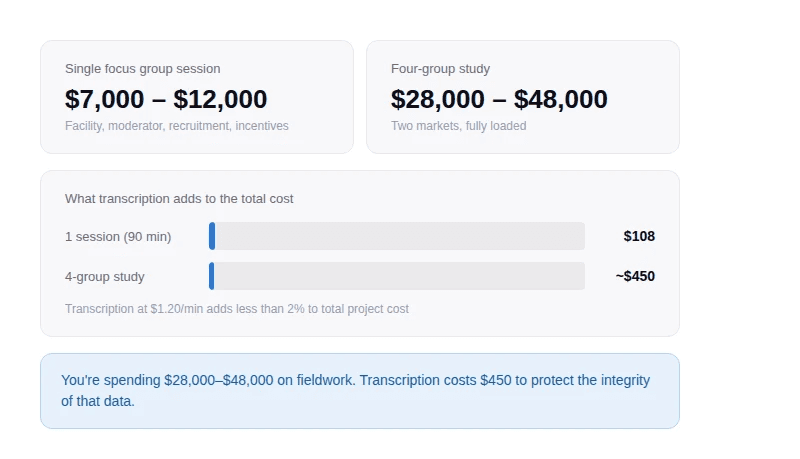
A single US focus group session costs $7,000 to $12,000 fully loaded, covering facility rental, moderator fees, participant recruitment, and incentives. A four-group study across two markets runs $28,000 to $48,000. In-depth interview programs of 10 to 15 sessions with specialist audiences can exceed $50,000.
"While having group discussions transcribed costs some money, it ends up saving money overall because of the amount of time it saves the moderator in the analysis phase."
Athena Brand Wisdom, Focus Group Research Costs Explained
Against that investment, professional focus group transcription typically costs $1.20 per minute for standard delivery. A 90-minute session runs roughly $108. For a four-group study, full transcription of all sessions costs under $450.
The math is not subtle. You're spending $28,000 to $48,000 on fieldwork and considering whether to spend $450 to protect the integrity of the data you just collected. The question isn't whether transcription is worth it. The question is why it's ever treated as optional.
Why "We Recorded It" Is Not Enough
Recording a session and transcribing it are not the same thing.
A recording that nobody goes back to review is functionally equivalent to no recording at all. Most research teams watch the recordings only when something specific needs to be verified, or when a client disputes a finding. In practice, a 90-minute recording gets watched in full almost never. Themes get confirmed from memory, quotes get paraphrased from notes, and the original audio sits on a server doing nothing.
A transcript changes this. The full 13,000 words of a session become searchable, sortable, and shareable. A researcher who wasn't in the room can read it and form their own view of what participants actually said. Themes can be identified systematically rather than from memory. Quotes can be pulled verbatim rather than reconstructed.
There's also the timing problem. Research teams typically debrief within 24 to 48 hours of fieldwork, when memory is freshest. But the quality of analysis is inversely proportional to how much the analyst is relying on memory rather than a written record. The debrief that happens 24 hours after the session, from notes alone, is the weakest analytical moment in the entire research process, and it's where most qualitative research conclusions are formed.
What a Transcript Enables That Notes Cannot
Verbatim quotes that hold up. A paraphrase is not a quote. "She said something about the packaging feeling cheap" is not the same as "The packaging looks like it came from a dollar store, not somewhere I'd actually want to shop." The second version is a quote a strategist can use in a presentation, a creative brief, or a client report. The first version is a memory. Research that relies on paraphrase produces reports full of assertions without evidence. Research built on transcripts produces reports where the participant's own words carry the argument.
Coding across sessions. One of the most powerful things you can do with qualitative data is identify a theme across multiple sessions, how many participants in how many groups mentioned the same concern, in their own words, unprompted. This kind of cross-session analysis is nearly impossible to do systematically from notes. From transcripts, it's straightforward. You can search for a term across every session, pull every instance, and build a quantified picture of how frequently a theme appeared, something qualitative research is often criticized for not providing.
Analysis by someone who wasn't in the room. The moderator and the backroom observers are not neutral. They were physically present, emotionally invested in the session, and subject to all the same confirmation biases as anyone else. A fresh analyst reading the transcript cold, without having been in the room, will often see things the original team missed. This is not a criticism of the original team. It's a structural advantage of having a written record.
Longitudinal comparison. If you're running tracker research, concept testing across waves, or brand health studies over time, transcripts are what make genuine comparison possible. Comparing notes from 2023 with notes from 2026 is unreliable. Comparing transcripts is not.
The Quotes That Don't Survive the Debrief
Consider what typically gets lost between the session and the debrief.
The comment said quietly, almost as an aside, that one participant later admitted changed how they thought about the whole category. The moment where two participants disagreed sharply before finding an unexpected middle ground. The hesitation before answering a question that suggested the research was touching something real. The word a participant used to describe the product that nobody in the backroom had ever heard before, because it came from how people in that community actually talk about this problem.
Notes capture what people said. Transcripts capture how they said it, in what order, in response to what, and in what context. For research meant to surface insight rather than just confirm hypotheses, that difference is the whole point.
Where Smart Insights Change the Analysis Timeline
For market research teams under deadline pressure, the gap between fieldwork completion and first analysis has historically been a bottleneck. Human transcription turnaround of three to five days means the debrief happens from notes, and the full transcript arrives after the initial conclusions have already been formed.
Qualtranscribe's Instant Draft closes this gap. AI transcription delivers a full draft within minutes of upload, alongside Smart Insights that automatically surface recurring themes, key quotes, and sentiment patterns across the session. A research team that uploads the recording immediately after the session finishes has a working transcript and a preliminary thematic read before the moderator has even written up their debrief notes.
This doesn't replace human transcription for sessions where verbatim accuracy is non-negotiable. It means the first analysis can start before memory has had time to reconstruct the session. For a four-group study running sessions on consecutive days, that's the difference between analyzing with fresh data and analyzing with four-day-old notes.
The Clinical and Pharma Dimension
In healthcare and pharmaceutical market research, the stakes of incomplete or inaccurate data capture are higher than in consumer research. KOL interviews, patient advisory board discussions, and payer research sessions feed directly into regulatory submissions, commercial strategy, and medical affairs positioning. A misremembered quote from a KOL advisory board isn't just an analytical inconvenience. It's a strategic error built on bad data.
HIPAA, GDPR, and for Japan-based research, APPI, govern how participant data is handled throughout the research process, not just after analysis. A transcript that exists under proper compliance documentation, with encrypted transfer, NDA-backed confidentiality, and a defined retention and deletion timeline, provides the audit trail that regulated research requires. Notes from a backroom observer do not.
What Professional Transcription Actually Protects
It protects the quote that changes the brief. The insight a junior analyst notices on a re-read three months later. The participant who disagreed with everyone else and was right. The product language that becomes the campaign headline. The concern that, if the team had heard it clearly at the time, would have redirected six months of development.
None of that is recoverable from notes after the fact. All of it is in the transcript.
Ready to make sure nothing leaves the room without a written record? Get started here.
FAQ
How much does it cost to transcribe a 90-minute focus group session? At Qualtranscribe's standard rate of $1.20 per audio minute, a 90-minute session runs roughly $108. Rush delivery at $1.60 per minute brings that to $144. Against a session cost of $7,000 to $12,000, transcription adds less than two percent to the total project cost.
Is AI transcription accurate enough for market research analysis? For a first-pass analysis and thematic read, yes. For verbatim quotes used in client deliverables or presentations, human-verified transcription is the more defensible choice. Qualtranscribe offers both, with Instant Draft for speed and human transcription for publication-grade accuracy.
How soon after a session should transcription be ordered? Immediately. The longer the gap between session and transcript delivery, the more the analysis relies on notes and memory rather than what was actually said. Uploading immediately after the session means a draft transcript can be available before the debrief.
Can transcription help with multi-session qualitative studies? Significantly. Cross-session analysis, identifying how often a theme appears across multiple groups, in what language, with what variation, is one of the most valuable things qualitative research can do and one of the hardest to do from notes. Transcripts make it systematic.
What's the difference between a transcript and a summary report? A summary report reflects the analyst's interpretation of what happened. A transcript is a factual record of what was said. Both have their place, but a summary without an underlying transcript has no evidentiary foundation. Anyone reading it has to trust the analyst's memory and judgment rather than being able to check the original record.
Related Reading
Turn your recordings into analysis-ready transcripts.
Human Transcription
Clean verbatim and full verbatim transcripts, delivered by specialist transcriptionists
AI Transcription
Instant Draft powered by AI, with Smart Insights for analysis-ready output
Translation Services
Accurate translation across 99+ languages for multilingual research workflows
Keep reading
Related articles

How to Write a Transcription Data Management Plan for IRB Submission
Most IRB protocols get sent back for revision on the data security and management sections, and within those sections, transcription is the specific area where protocols most frequently fall short. The reasons are consistent: researchers describe their interview methodology in careful detail, specify their analysis software, and then write a single sentence about transcription that doesn't address who's doing it, what compliance standards the vendor meets, how files will be transferred, where they'll be stored, or when they'll be deleted.
Read article

Spanish Transcription for US Hispanic Research: Dialects, Generations, and What to Expect
A common setup in community-based Latino health research: bilingual interviews with first, second, and 1.5-generation participants, conducted in English or Spanish depending on each participant's preference, at community organizations across a Midwestern city. The recordings come back mixed. Some are fully in Spanish, some fully in English, some switching mid-interview as participants reach for the language that fits the concept they're describing. One transcriptionist flags the mixed recordings as too difficult. Another delivers transcripts where heritage speaker constructions have been silently corrected to standard Spanish. The researcher is now reviewing every transcript manually before analysis can begin. This is the predictable result of sending US Hispanic research recordings, whether from one-on-one interviews, focus groups, or Zoom, Teams, and Webex sessions, to transcription services built for standard, monolingual speech.
Read article

The Best Transcription Services for Focus Groups in 2026
Focus groups generate some of the most demanding audio in qualitative research. Six to twelve people talking, sometimes over each other, sometimes in a room with bad acoustics, sometimes over a Zoom call with background noise from a home environment. Getting that audio into a clean, usable transcript is where a lot of research budgets and timelines get tested. Not every transcription service handles this well, and the right one often depends on the kind of focus group you're actually running.
Read article
© 2026 Qualtranscribe LLC. Services Provided Globally