
•

Diversity in focus groups doesn't happen by accident. It requires choosing the right sampling strategy upfront, writing a screener that captures the variation you need rather than accidentally filtering it out, and removing the practical barriers, timing, language, compensation, location, that quietly screen out the participants you most need to hear from. If your analysis shows three people drove most of the discussion, the diversity problem started at recruitment, not in the room.
Choose Your Sampling Strategy Before You Recruit Anyone
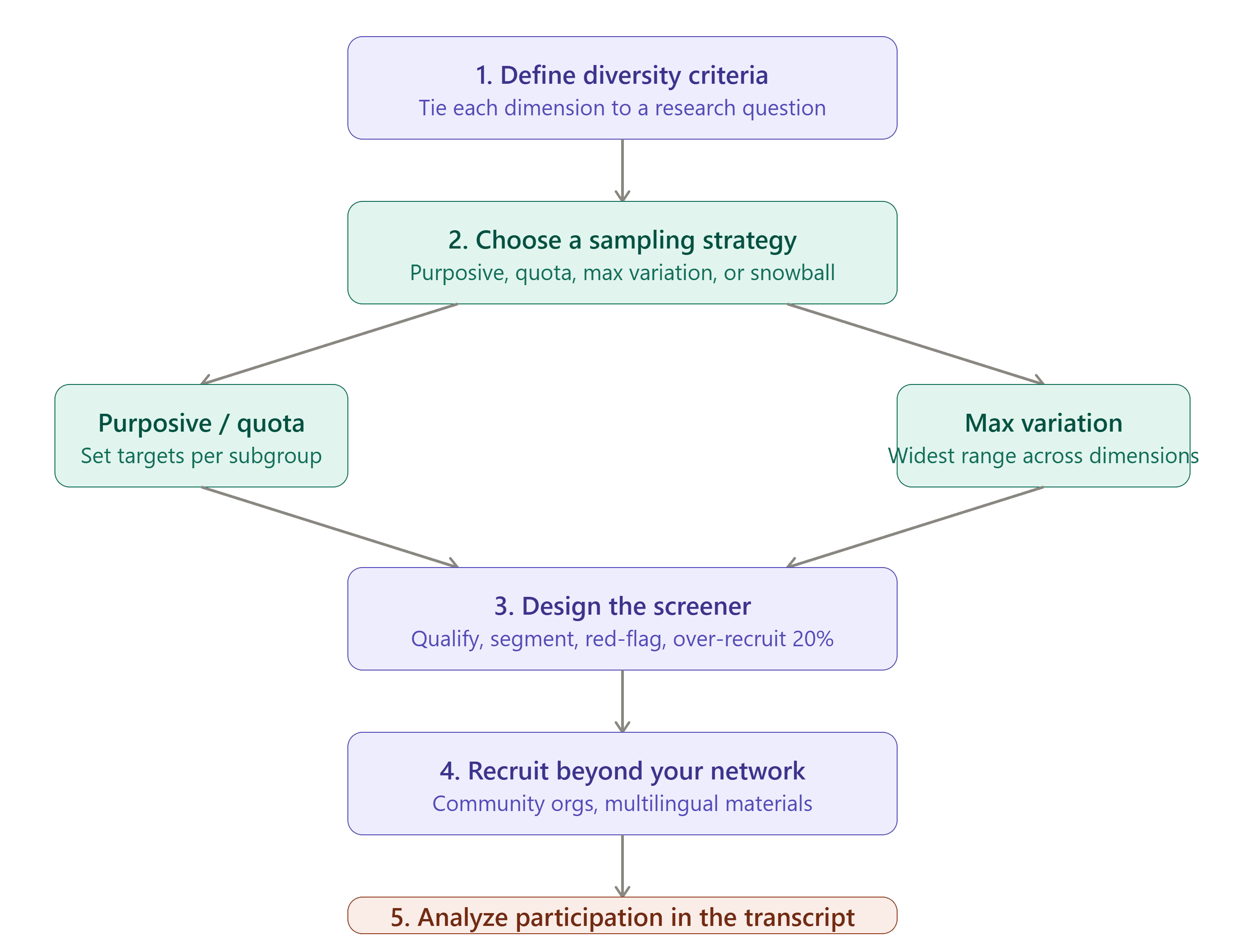
Focus group sampling is purposive, not random. The goal isn't statistical representativeness the way a survey sample aims for, it's ensuring participants can actually provide the range of perspectives relevant to your research question. That choice of strategy should be deliberate, not assumed.
Purposive sampling is the baseline for most focus group work. You select participants based on specific criteria that match your research objectives. A study on healthcare access barriers might select purposively for geography, income level, insurance status, and primary language. The criteria should come from the research questions, not from whoever happened to respond to your recruitment post.
Maximum variation sampling deliberately seeks participants whose backgrounds and experiences differ as much as possible along the dimensions that matter for your study. Krueger and Casey's widely cited principle is homogeneity within groups and diversity across groups: each session should be composed of people who share enough in common to talk comfortably together, while the overall study design ensures variation across sessions. Running separate groups for different segments and comparing findings across them is often more analytically useful than forcing maximum diversity into a single room where status dynamics can suppress honest responses.
Quota sampling sets specific numerical targets for subgroups you want to represent. If your study needs equal voice from rural and urban participants, you set firm quotas rather than hoping the natural response rate produces the right balance. Quotas require more recruitment effort upfront but prevent the common outcome where one segment outnumbers another simply because they were easier to reach.
Snowball sampling helps reach communities that are hard to access through standard channels, where existing participants refer others from the same network. It's useful for specific community groups, minority populations, or people with shared experiences that don't show up easily in a survey panel. The risk is tight social clusters rather than genuine variation, so it works best as one component of a broader strategy, not the whole of it.
Here's how the four strategies compare:
Sampling Strategy | How It Works | Best For | Risk |
|---|---|---|---|
Purposive | Select participants based on specific criteria tied to your research question | Most focus group studies, especially with defined target groups | Depends on who you can actually reach within those criteria |
Maximum variation | Deliberately seek the widest possible range across relevant dimensions | Exploratory research, community studies, identifying shared themes across difference | Can create dynamics where participants feel too different to engage freely |
Quota | Set fixed numerical targets per subgroup and recruit until each is filled | Multi-segment market research, studies comparing demographic groups | Harder-to-reach groups slow the whole process |
Snowball | Existing participants refer others from their network | Hard-to-reach communities, niche populations, trust-dependent recruitment | Risk of tight social clusters rather than genuine variation |
Convenience sampling, using whoever's available and willing, is the default that most diversity problems trace back to. Focus group samples built on convenience have severe bias and usually a lack of diversity. Avoiding it is the price of data that actually reflects your target population.
Define Diversity Specifically for Your Study
"Diverse" isn't a criterion. It's relative to what you're researching, and getting this wrong early makes every subsequent step less useful.
Diversity can include demographics, psychographics, behavior, attitudes, opinions, preferences, and needs. A study on digital banking adoption might need variation in age, income, tech comfort, and urban/rural location. The same study in a different context might need variation in immigration status and primary language instead. There's no universal diversity checklist because the relevant dimensions come from the research question, not from a template.
Write the specific dimensions down before you design your screener. Each one should map to a research question. If a dimension you're considering doesn't affect what you'd learn from the session, it probably isn't worth the recruiting complexity.
Design a Screener That Actually Works
The screener is where diversity gets built in or accidentally filtered out. Most screener problems fall into two failure modes: too loose and anyone qualifies, or too tight and you've screened your way to a narrow, convenient group without meaning to.
A well-structured screener moves through qualification criteria first (does this person belong in the study at all?), then variation criteria (which subgroup do they represent?), then red flags to catch enthusiastic yes-sayers who claim to qualify for everything. That last category matters more than it gets credit for. A question listing several product categories and asking which ones the respondent uses regularly will sometimes reveal people who enthusiastically select every option simply because they want to participate, regardless of whether they actually qualify.
Quota tracking runs parallel to the screener. Once a subgroup's quota is filled, additional respondents who qualify for that group get waitlisted rather than added. This keeps the composition intentional rather than a product of who responded first.
Over-recruit by at least 20 percent for each session. If you need 8 participants and recruit exactly 8, a single no-show creates a thin group. Recruit 10 to 12 to reliably land 8 in the room.
Recruit Beyond Your Own Networks
If recruitment happens exclusively through your email list, social media following, or existing customer database, the resulting group reflects the people who already know you. That might be exactly who you need. Often it isn't.
Real diversity usually means going where different people already spend time: community centers, faith organizations, libraries, neighborhood apps, social service agencies, community health clinics, local professional associations, and school networks. Partnerships with organizations that already have trust in the communities you're trying to reach tend to produce better results than a cold recruitment effort, because the referral comes from someone the potential participant already knows.
For multilingual communities, recruitment materials need to exist in the relevant languages. English-only outreach doesn't just fail to reach non-English speakers, it signals to bilingual participants that the session may not have been designed with them in mind. If Spanish-speaking participants are part of your target, the flyer, screener, and compensation communication should all be available in Spanish. The same logic applies to any other language relevant to your study.
Remove the Barriers That Screen People Out Quietly
A lot of diversity gaps come from practical friction rather than explicit exclusion. Weekday morning sessions screen out hourly workers. Single-location in-person sessions screen out people without transportation. No childcare option screens out parents of young children. English-only sessions screen out non-native speakers even when they qualify in every other way. Insufficient compensation screens out people who can't afford to give up several hours without meaningful pay.
None of these are intentional. Each one narrows the participant pool in ways that correlate with the demographic variation you're most trying to capture.
Offering virtual options removes geographic and transportation barriers and tends to broaden diversity across geographic and socioeconomic lines. Scheduling across multiple time slots, including evenings and weekends, expands access to working participants. Adequate compensation is a fairness issue that also happens to reduce selection bias toward participants who can afford to participate without pay.
Choose a Moderator Who Can Work With the Specific Group
Who leads the session shapes what people are willing to say in it. A diverse participant list won't automatically produce diverse data if the moderator doesn't know how to create space for quieter participants to speak, doesn't recognize when one voice is crowding out others, or is unfamiliar with the cultural context of the group they're working with.
Cultural fluency matters here: a moderator who doesn't recognize when a response is polite deflection rather than genuine opinion, or who doesn't understand the social dynamics of a specific community, will miss things that a more culturally matched moderator would catch.
Match the moderator to the specific group and topic. The most experienced moderator in general isn't necessarily the right one for a given community. For multilingual sessions, a co-moderator or interpreter fluent in the relevant language is the difference between capturing what participants actually said and losing it.
Check Who Actually Spoke During Analysis
After the session, before thematic analysis begins, look at participation patterns. Who spoke most? Who spoke least? Did certain views cluster in specific demographic segments? Did anyone seem reluctant to disagree with the dominant voice in the room?
Your transcript is where this check becomes concrete. With clear speaker labels throughout, you can see at a glance whether quiet participants contributed meaningfully or whether three voices drove 80 percent of the discussion. If the session was multilingual, Qualtranscribe handles transcription and translation across 25 languages with the same speaker-labeling accuracy applied regardless of which language a participant spoke in, so those contributions aren't approximated or lost.
Insights buried under a dominant voice are still in the recording. A clean, speaker-labeled focus group transcript is how you find them.
Homogeneous vs. Diverse Groups: When Each Applies
Not every study calls for maximum variation within each session. For some studies, homogeneous groups work better. For others, diversity within groups sparks richer conversation. The choice depends on research goals and whether status dynamics might suppress honest discussion.
Homogeneous groups, all heavy users, all first-time buyers, all participants from a specific demographic segment, can produce richer discussion precisely because participants don't have to explain their context to each other. Running separate sessions with different segments and comparing findings across them is often more analytically productive than managing diversity within a single session.
The question is what kind of diversity actually serves the research question. Within-group homogeneity with cross-group variation is a legitimate and often powerful study design. Mixing everyone into one session and hoping it produces useful data is a different thing entirely.
For market research studies, segmenting by usage level or demographic profile and running separate sessions tends to produce more actionable findings, because the comparison across segments is where the insight usually lives. For academic research and community studies, the research question drives the design more directly. Dissertation research benefits from a clearly documented sampling rationale, since IRB reviewers and committee members will want to see that participant composition was intentional. The same logic applies to qualitative interview transcription: who you selected and why should be as documented as what they said.
Need to capture every voice accurately in your next focus group, including multilingual sessions? Get started here.
FAQ
How many participants should a diverse focus group include? Most sessions run 6 to 10 participants. Fewer than six limits the discussion range; more than ten and some voices get crowded out. Within that range, composition matters more than number. Many experienced moderators prefer 6 to 8 as the range where everyone can contribute meaningfully.
What's the difference between purposive and quota sampling for focus groups? Purposive sampling selects participants based on specific criteria relevant to the research question. Quota sampling adds a numerical target for each subgroup so representation is guaranteed rather than left to chance. Most rigorous focus group studies use both together.
Is it better to have diverse participants within each group or across groups? Both have value. Within-group diversity can produce richer cross-perspective discussion but risks status dynamics suppressing honest responses. Diversity across groups, running separate homogeneous sessions and comparing findings, tends to be more analytically useful in market research and structured studies.
What's the most common reason focus groups end up homogeneous? Convenience sampling: recruiting from the easiest available source rather than designing composition intentionally. The second most common reason is a screener that accidentally filters out the desired variation, or that fills quickly with the easiest-to-reach subgroup before quotas for harder-to-reach groups are met.
How do I handle multilingual sessions so non-English speakers contribute equally? Plan for it at recruitment, not in the room. Provide materials in the relevant languages, use a moderator or co-moderator fluent in those languages, and use a transcription service that handles multilingual audio with accurate speaker labeling so no participant's contribution gets approximated or lost during analysis.
What should I check in a transcript after a diverse focus group? Look at who spoke and how much, whether certain views clustered in specific demographic segments, and whether quieter participants contributed meaningfully or were crowded out. That's how you know whether the diversity you recruited for actually produced diverse data.
Related Reading
Turn your recordings into analysis-ready transcripts.
Human Transcription
Clean verbatim and full verbatim transcripts, delivered by specialist transcriptionists
AI Transcription
Instant Draft powered by AI, with Smart Insights for analysis-ready output
Translation Services
Accurate translation across 99+ languages for multilingual research workflows
Keep reading
Related articles

The Best Transcription Services for Focus Groups in 2026
Focus groups generate some of the most demanding audio in qualitative research. Six to twelve people talking, sometimes over each other, sometimes in a room with bad acoustics, sometimes over a Zoom call with background noise from a home environment. Getting that audio into a clean, usable transcript is where a lot of research budgets and timelines get tested. Not every transcription service handles this well, and the right one often depends on the kind of focus group you're actually running.
Read article

Portuguese Transcription in Latin American Field Research: A Practical Guide
A research team returns from fieldwork across São Paulo, Recife, and Porto Alegre. Three cities, three clearly distinct accents, two weeks of interviews. Back at the institution, someone books a Portuguese transcriptionist. Nobody specifies which variety of Portuguese they need. The transcripts come back with Nordestino expressions normalized to São Paulo usage, a participant whose name appears in three different spellings, and no timestamps. Technically, the words are mostly right. As research data, the transcripts are close to unusable. This happens because transcription for field research in Brazil requires decisions that general transcription services don't prompt researchers to make.
Read article

How to Turn a 60-Minute Webex Recording into a 2-Minute Read
Picture this: someone drops a Webex link in your inbox with a note saying the answer to your question is "somewhere in the recording." Or you ran a 60-minute KOL interview three days ago, need to quote it accurately in a briefing, and your memory of what was said is already fuzzing at the edges.
Read article

© 2026 Qualtranscribe LLC. Services Provided Globally