
•
• Sensitive recordings can include personal data, so transcription workflows need clear privacy safeguards. • Secure providers should use encrypted transfer, limited access, deletion policies, and documented data handling. • Clients should ask vendors about agreements, breach response, storage practices, and who can access files. • A compliant transcription process protects participants, reduces risk, and builds trust with research or healthcare teams.
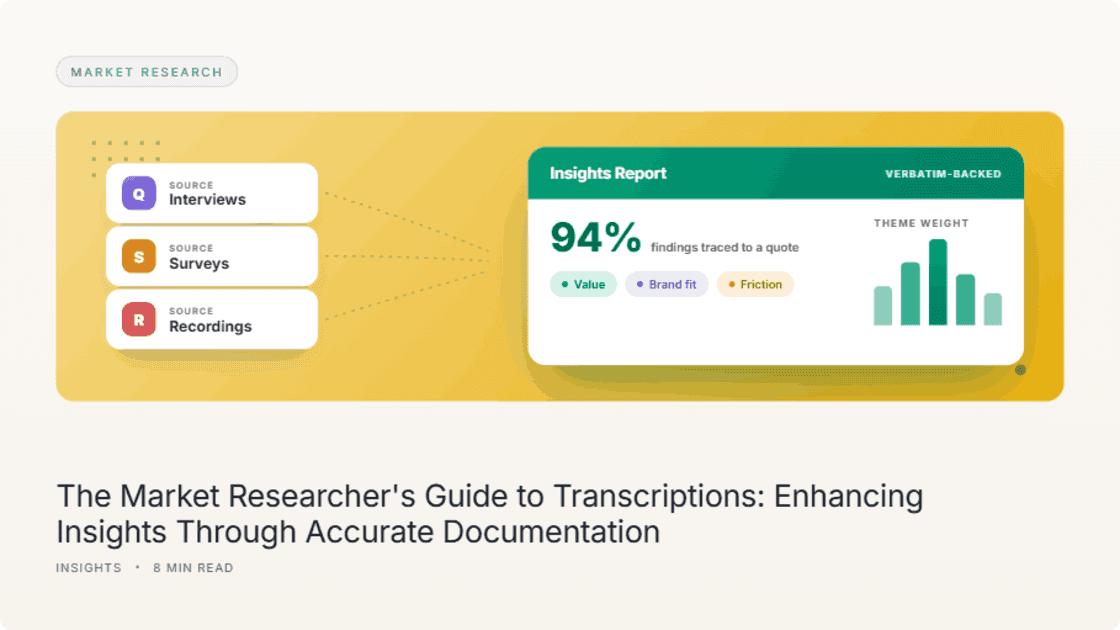
When you're deep in market research, every detail matters. Whether you're running interviews, focus groups, or usability tests, you're collecting valuable insights. But if all that rich information stays buried in audio or video files, you're only getting part of the picture. That’s where transcription comes in. At Qualtranscribe, we help market researchers turn spoken data into clear, accurate transcripts that make analysis easier and more effective. In this guide, we’ll walk you through how transcription fits into the research process, why it matters, and how to get the best results from it. Why Transcription Is a Must in Market Research If you're working with qualitative data, like interviews or discussions, you already know how much time it takes to go back and forth through audio. Transcripts solve that problem by giving you a searchable, scannable version of your research. Here’s why market researchers rely on transcription: It saves time. You can quickly scan, highlight, and tag quotes. It boosts accuracy. You're not guessing what someone said, you have it in writing. It helps with collaboration. Transcripts are easy to share with teammates. It makes compliance easier. Having a written record helps meet ethical and privacy standards. It brings clarity. Seeing the words laid out on a page often reveals patterns that aren't obvious when you're just listening. Related: A Mixed Methods Approach to Market Research Types of Market Research Transcription We Support Every project is a little different. Here's a look at the main types of transcription we handle for market research clients: 1. One-on-One Interviews These are the heart of many qualitative research projects. Whether it's in person or remote, our team captures every word clearly so you can focus on the meaning behind it. 2. Focus Groups Multiple voices, fast exchanges, overlapping dialogue, it can get messy fast. We handle the complexity and clearly identify speakers so you don’t miss a thing. 3. Usability Testing When participants are testing apps, products, or websites and giving feedback, transcripts help you spot usability issues, preferences, and pain points. 4. Mobile Diaries and Ethnography Sometimes participants send in voice notes or video clips over several days. We turn those into structured text that makes tracking trends and behaviors much easier. 5. Mystery Shopping Reports Audio recordings from mystery shoppers can offer great feedback. We transcribe them so you can easily compare service experiences across locations. 6. Video Content Transcription Whether it’s reaction videos, panel discussions, or interviews, we turn your video content into clean, readable transcripts. This is especially useful for captioning, editing, or repurposing content. You can also explore our article on Focus Group Transcription Services for more insights. What Kind of Transcript Do You Need? Not all transcripts are created the same. Here are your options: Full Verbatim: Includes every word, filler, pause, and false start. Ideal if you're analyzing tone, hesitation, or speech patterns. Clean Verbatim: Skips the “ums” and stutters but keeps the core message intact. This is what most researchers prefer, clear, clean, and easy to read. Summary Transcripts: Condensed versions with just the key points. Helpful for high-level review or when you’re short on time. We usually recommend clean verbatim for market research, unless you're doing a detailed linguistic analysis. Related: Which Verbatim Style Is Best for Interviews, Focus Groups, or Research? How to Record for Better Transcription Results You don’t need fancy equipment, but a few smart steps can go a long way: Use a reliable recorder or app. Pick a quiet place with minimal background noise. Introduce each speaker at the beginning. Avoid crosstalk. Let people finish speaking before others jump in. Get consent. Always let participants know they’re being recorded. Good recordings mean faster delivery and fewer questions later. Privacy and Confidentiality You Can Count On Market research often involves sensitive topics or unreleased products. Your data security is our top priority. Here's how we protect your files: We use Citrix ShareFile, a secure cloud platform, for all file transfers. Files are encrypted at rest and in transit. Every transcriptionist signs a confidentiality agreement. We follow data protection regulations, including GDPR and HIPAA. All files are automatically deleted after 7 days, unless you request otherwise. You can choose to have us remove personal identifiers from transcripts. We do not use AI or machine learning tools, your data stays with human professionals and never gets used to train algorithms. Using Transcripts in Your Research Tools Once your transcripts are ready, you can import them into tools like: NVivo Atlas.ti Dedoose MaxQDA Read more on How Transcription Can Help You Find Patterns in Qualitative Data. Having clean, formatted transcripts makes it easier to code data, pull quotes, and build out your themes. Why Work With Qualtranscribe? We’re not just a transcription provider, we’re a research partner. Here’s what you can expect from us: Real humans who understand the context of your research Fast turnarounds, even for large projects Rolling delivery so you can begin analysis sooner A dedicated project manager who keeps everything running smoothly Experience working with NGOs, academic institutions, and research firms globally If you're working on a multi-language project, we also provide transcription and translation services in major African, European, and Asian languages. Wrapping Up Transcription isn't just about turning speech into text. It's about making your research stronger, your insights clearer, and your job easier. At Qualtranscribe, we help you get the most out of your data,accurately, securely, and on time. Ready to get started or need a quote? Contact us or learn more about our market research transcription services.
Turn your recordings into analysis-ready transcripts.
Human Transcription
Clean verbatim and full verbatim transcripts, delivered by specialist transcriptionists
AI Transcription
Instant Draft powered by AI, with Smart Insights for analysis-ready output
Translation Services
Accurate translation across 99+ languages for multilingual research workflows
Keep reading
Related articles

The Best Transcription Services for Focus Groups in 2026
Focus groups generate some of the most demanding audio in qualitative research. Six to twelve people talking, sometimes over each other, sometimes in a room with bad acoustics, sometimes over a Zoom call with background noise from a home environment. Getting that audio into a clean, usable transcript is where a lot of research budgets and timelines get tested. Not every transcription service handles this well, and the right one often depends on the kind of focus group you're actually running.
Read article

Portuguese Transcription in Latin American Field Research: A Practical Guide
A research team returns from fieldwork across São Paulo, Recife, and Porto Alegre. Three cities, three clearly distinct accents, two weeks of interviews. Back at the institution, someone books a Portuguese transcriptionist. Nobody specifies which variety of Portuguese they need. The transcripts come back with Nordestino expressions normalized to São Paulo usage, a participant whose name appears in three different spellings, and no timestamps. Technically, the words are mostly right. As research data, the transcripts are close to unusable. This happens because transcription for field research in Brazil requires decisions that general transcription services don't prompt researchers to make.
Read article

How to Turn a 60-Minute Webex Recording into a 2-Minute Read
Picture this: someone drops a Webex link in your inbox with a note saying the answer to your question is "somewhere in the recording." Or you ran a 60-minute KOL interview three days ago, need to quote it accurately in a briefing, and your memory of what was said is already fuzzing at the edges.
Read article
© 2026 Qualtranscribe LLC. Services Provided Globally