
•
5 mins
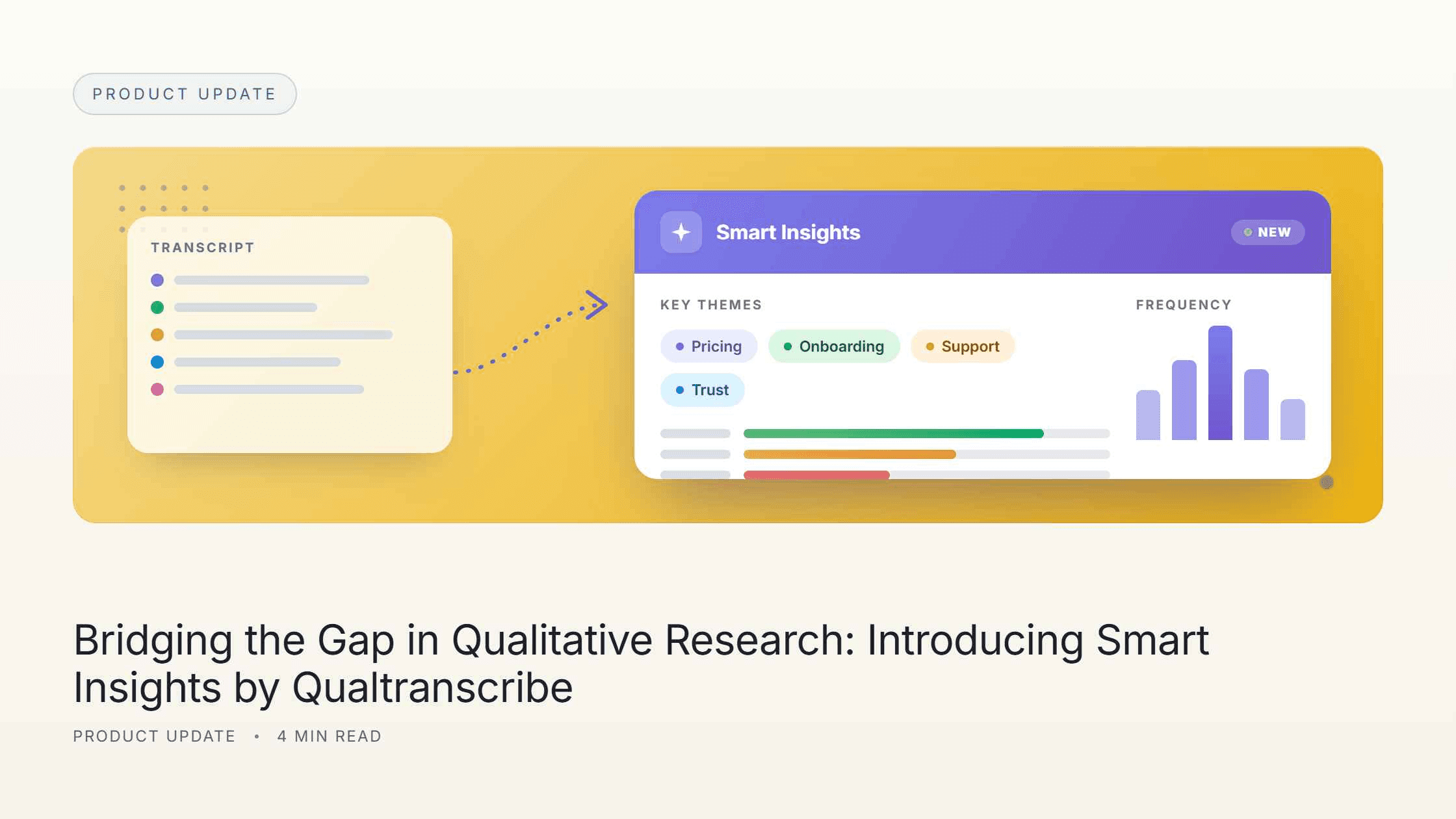
Smart Insights by Qualtranscribe is an AI-powered analysis tool designed to bridge the gap between raw transcripts and final findings. What it does: It accelerates thematic analysis by automatically generating thematic maps, speaker behavior breakdowns, emotion visualisations, research memos, and structured CSV exports for software like NVivo and ATLAS.ti. The Philosophy: It does not replace human transcription or human analysis. It acts as a super-fast research assistant to get you to the starting line quicker, leaving the deep interpretive work to you. Security: It is fully secure and IRB-compliant, featuring a strict no-AI-training policy, encryption, and a formal BAA for sensitive or healthcare data.
As Qualtranscribe’s AI-powered analysis layer, Smart Insights is designed specifically for researchers who need faster thematic analysis and research-ready outputs without compromising academic rigor. It does not replace human analysis. Instead, it gets you to the starting line faster so your analytical expertise can do what it does best.
Why Human Transcription Still Comes First
Before diving into AI capabilities, let’s be straightforward: human transcription remains the most accurate and reliable way to capture qualitative interview data. This isn’t a throwaway disclaimer; it’s a core belief that shaped how we built Smart Insights.
A skilled human transcriptionist understands nuance that AI misses:
The difference between a meaningful pause and an audio dropout.
When a participant trails off mid-sentence in an analytically important way.
Nervous laughter versus genuine amusement.
Ambiguity caused by crosstalk.
For research involving sensitive populations, non-standard dialects, heavy multi-speaker overlap, or academic work destined for peer review, human transcription is the right choice.
The Perfect Workflow: Use Qualtranscribe's professional, research-grade Human Transcription Services (including Clean Verbatim, Academic, and Focus Group formats compatible with NVivo and ATLAS.ti). Then, layer on Smart Insights when your project demands speed, scale, or a rapid preliminary analysis.
The Challenge: Why Researchers Need Faster Thematic Analysis
Qualitative data analysis is notoriously time-intensive. A single 90-minute In-Depth Interview (IDI) can take 4 to 6 hours to code thoroughly. A project with just 12 participants can result in weeks of analytical work before your first debrief.
Traditional workarounds fall short:
Outsourcing analysis entirely compromises interpretive integrity.
Rushing the process produces shallow, superficial findings.
Skipping preliminary passes means entering deep coding without a map of the terrain.
While general AI text tools exist, they aren't built for the specific demands of qualitative research methodologies. Smart Insights is different because it was designed from the ground up to format outputs exactly how qualitative researchers actually work.
What Smart Insights Generates (And Why It Matters)
Once your transcript is ready, Smart Insights analyzes the full content of the interview to generate a complete suite of research-ready outputs:
1. Thematic Analysis
Automatically identifies recurring themes and organizes them into a structured thematic map. This is not a basic word frequency count—it is pattern recognition that surfaces the core ideas, tensions, and narratives running through the conversation, giving you a first-pass coding framework.
2. Speaker Pattern Analysis
Crucial for focus groups and multi-participant IDIs, this feature breaks down contributions by speaker. It highlights patterns in participation, agreement, divergence, and topic ownership, helping you see how group dynamics shaped the conversation.
3. Emotion Mapping & Timeline Visualisation
Maps emotional tone across the length of the interview, producing a visual timeline of where sentiment, energy, and engagement shifted.
(Note: Treat this as a useful research prompt and first-pass signal, not a clinical measurement).
4. Research Memos
Generates ready-to-use research summaries of key observations. These are perfectly formatted for team sharing, project documentation, or as a starting framework for your final write-up.
5. Coding CSV Export
Saves hours of setup time by generating a structured CSV file formatted for direct import into QDA software like NVivo and ATLAS.ti, letting you jump into deep coding immediately.
6. Theme Summaries with Participant Quotes
Pairs each identified theme with a concise summary and supporting quotes pulled straight from the transcript—ideal for reference points, final reports, and stakeholder presentations.
7. Findings Deck Outline
Produces a structured outline to help turn your interview findings into a presentation or report, drastically reducing the time between analysis and delivery.
Built for Research Ethics and Confidentiality
Participant narratives regarding health, identity, and personal experiences carry immense ethical weight. Smart Insights was built to meet the strictest institutional data governance standards:
Zero AI Model Training: Neither Qualtranscribe nor AssemblyAI will ever use your transcripts, recordings, or participant data to train AI models. Your data is processed to produce your outputs, and then it is gone.
Business Associate Agreement (BAA): Audio processing is handled via AssemblyAI under a formal BAA legal data protection agreement, not just a standard terms of service. This is critical for healthcare data and vulnerable populations.
Encryption and File Deletion: Files are encrypted in transit and deleted immediately after processing, aligning perfectly with standard data minimization principles.
IRB Compliance Documentation: Our security practices, data deletion policies, and no-training commitments are fully documentable and ready to be referenced in your Institutional Review Board (IRB) or ethics review submissions.
(For more on our data security standards, see QualShield and our HIPAA compliance documentation).
Who Uses Smart Insights?
User Group | How It Helps |
Academic & PhD Researchers | Moves you from dissertation fieldwork or longitudinal studies to preliminary thematic frameworks quickly. |
Market Research & Insights Teams | Surfaces themes and patterns faster on tight agency timelines without sacrificing interpretive depth. |
Focus Group Moderators | Maps complex group dynamics, showing where consensus formed and where opinions diverged. |
UX & Product Researchers | Delivers rapid first-pass analysis on user interviews so product teams can iterate without delay. |
Healthcare & Social Scientists | Provides the speed of AI backed by the rigid data privacy (BAA, HIPAA, IRB support) required for sensitive data. |
A Genuine Note on What AI Gets Wrong
Smart Insights is incredibly powerful, but it is still an AI tool. AI can make mistakes—sometimes confidently.
The themes are a starting point for your analysis, not a conclusion.
The emotion mapping is an approximation, not a clinical assessment.
The memos are a first draft, not a finished product.
Speaker attribution can occasionally misfire during heavy crosstalk.
Think of Smart Insights as a research assistant who is exceptionally fast, has read everything, but has never actually conducted an interview. They can organize information at an unmatched scale, but they lack interpretive judgment, lived experience, and methodological wisdom.
That is your job. Rigorous qualitative research still requires a rigorous qualitative researcher. Always interrogate the outputs, cross-check themes against the transcript, and bring your own expertise to the interpretation.
Get Started
Ready to accelerate your research workflow?
Try the AI tool: Visit the Qualtranscribe Smart Insights Studio.
Need human transcription first? Our professional team is ready.
Turn your recordings into analysis-ready transcripts.
Human Transcription
Clean verbatim and full verbatim transcripts, delivered by specialist transcriptionists
AI Transcription
Instant Draft powered by AI, with Smart Insights for analysis-ready output
Translation Services
Accurate translation across 99+ languages for multilingual research workflows
Keep reading
Related articles

The Best Transcription Services for Focus Groups in 2026
Focus groups generate some of the most demanding audio in qualitative research. Six to twelve people talking, sometimes over each other, sometimes in a room with bad acoustics, sometimes over a Zoom call with background noise from a home environment. Getting that audio into a clean, usable transcript is where a lot of research budgets and timelines get tested. Not every transcription service handles this well, and the right one often depends on the kind of focus group you're actually running.
Read article

Portuguese Transcription in Latin American Field Research: A Practical Guide
A research team returns from fieldwork across São Paulo, Recife, and Porto Alegre. Three cities, three clearly distinct accents, two weeks of interviews. Back at the institution, someone books a Portuguese transcriptionist. Nobody specifies which variety of Portuguese they need. The transcripts come back with Nordestino expressions normalized to São Paulo usage, a participant whose name appears in three different spellings, and no timestamps. Technically, the words are mostly right. As research data, the transcripts are close to unusable. This happens because transcription for field research in Brazil requires decisions that general transcription services don't prompt researchers to make.
Read article

How to Turn a 60-Minute Webex Recording into a 2-Minute Read
Picture this: someone drops a Webex link in your inbox with a note saying the answer to your question is "somewhere in the recording." Or you ran a 60-minute KOL interview three days ago, need to quote it accurately in a briefing, and your memory of what was said is already fuzzing at the edges.
Read article

© 2026 Qualtranscribe LLC. Services Provided Globally