
•
8 mins
The Ultimate Guide to Academic Transcription Services: Everything You Need to Know
You have just finished conducting 15 in-depth interviews for your dissertation. The conversations were rich, the participants were candid, and now you are staring at 22 hours of audio wondering how any of it becomes analyzable data. This is where most researchers hit a wall. Transcribing it yourself, at roughly four to six hours per hour of audio, means 88 to 132 hours of typing before you touch a single line of analysis. That is weeks of your life before your actual research begins. There is a better option. But the transcription services market is crowded, compliance requirements are real, and picking the wrong service can create problems that range from poor accuracy to outright IRB violations. This guide covers everything you need to make a good decision.
TL;DR
30 sec read
Here’s what you need to know
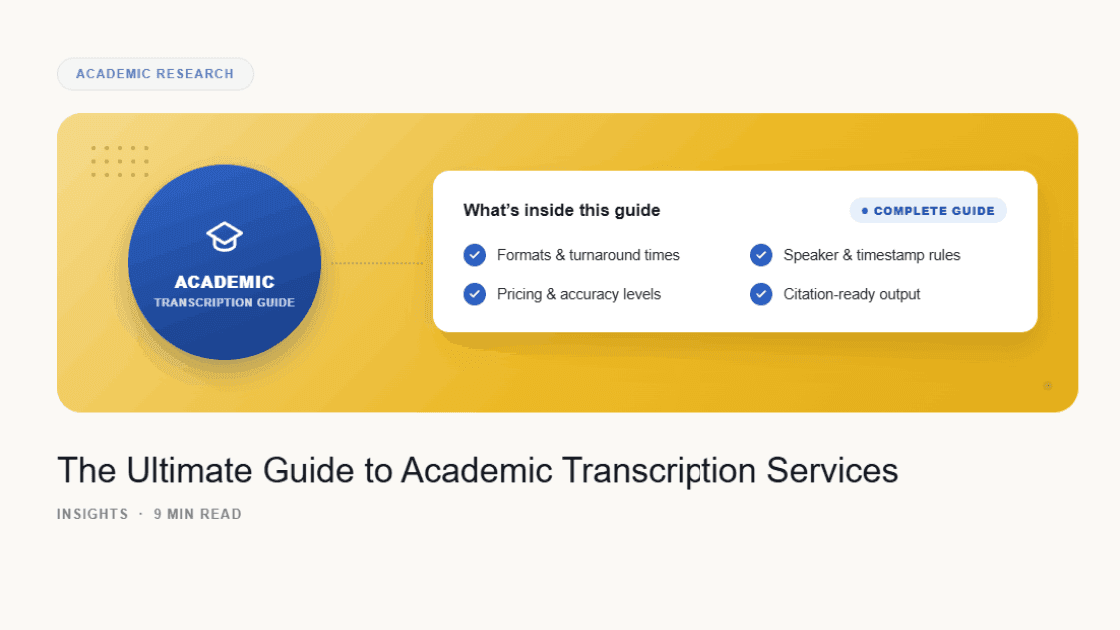
132 hours of typing or a professional service. Pick the service. Check three things before you order: IRB compliance, whether recordings are used for AI training, and whether transcripts come formatted for NVivo. Most cheap services fail at least one. Budget $1.20 to $2.00 per minute and build it into your grant from the start.
Best for researchers, compliance teams, and operations leaders evaluating transcription vendors.
Read the full guide ↓
What Academic Transcription Actually Is
Academic transcription converts audio or video recordings into written text for scholarly use. That covers qualitative research interviews, focus group discussions, recorded lectures, conference presentations, and dissertation defense recordings.
What separates it from general transcription is the accuracy standard. A misheard word in a business meeting transcript is an inconvenience. In research, it can change the meaning of a participant's statement and potentially invalidate a finding. The people doing the work need to understand research terminology, follow speaker identification conventions, and produce output that works with qualitative analysis software rather than just a readable document.
Researchers use transcripts to code and analyze data in NVivo, ATLAS.ti, MAXQDA, and Dedoose. Graduate students need them for dissertation research. Faculty at US colleges and universities use them to archive lectures or create accessible teaching materials. Multilingual projects add another layer: interviews conducted in one language, analyzed in another, requiring both transcription and translation in a single workflow.
Verbatim vs Intelligent Verbatim: Which One Do You Need
This decision matters more than most researchers realize, and getting it wrong creates real problems later.
Full verbatim captures everything spoken, including filler words, false starts, repetitions, and stutters. A participant might say something like:
"I, um, I think that, you know, the, uh, the program was, like, really helpful, you know?"
In a full verbatim transcript, that appears exactly as spoken, because those hesitations are part of the data. This level of detail matters for conversation analysis, linguistic research, or any study examining how participants communicate rather than just what they say.
Intelligent verbatim removes the filler words and verbal clutter while preserving the actual content. That same statement becomes:
"I think the program was really helpful."
The meaning is identical. The transcript is easier to work with. For most qualitative interviews and focus groups where you're interested in what participants said rather than how they said it, intelligent verbatim is the right call.
If you're not sure which applies to your methodology, check with your supervisor or look at how your analysis approach treats speech patterns. Discourse analysis typically requires full verbatim. Thematic analysis usually does not.
What to Look For in a Transcription Service
A lot of transcription services look similar from the outside. Here's what actually separates good ones from bad ones for research work.
Research experience. Ask whether they've worked with dissertation projects before. Do they understand IRB requirements? Can they format transcripts for qualitative analysis software? A service that primarily handles podcast transcription won't handle your 20-interview dataset the same way.
Quality control process. Good services have multiple review stages: initial transcription, a second pass for accuracy, a final check before delivery. If they can't explain their QC process clearly, that's a problem.
Turnaround time. Standard academic transcription typically runs three to seven business days depending on audio length and quality. Rush options in 24 to 48 hours usually cost more. If someone promises overnight turnaround on complex multilingual research content, they're cutting corners somewhere. For projects with many interviews, ask whether they can handle batches and whether the timeline works with your IRB deadlines.
Data security specifics. Not vague reassurances. Ask how files are transferred, where they're stored, who has access, how long data is retained, and what happens to recordings after the project ends. For HIPAA or GDPR-covered research, ask to see compliance documentation before sending a single file.
Revision policy. When you find errors, how quickly do they get fixed? Is there a limit on revision requests? Know this before committing.
Responsiveness. Email a question before ordering. How fast they respond, and how well they answer, tells you more than any feature list.
The AI Transcription Risk Most Researchers Miss
AI transcription tools are fast, cheap, and everywhere. They're also a serious problem for research involving human participants, and most researchers don't find out until it's too late.
Some AI transcription services use the files you upload to train their language models. The sensitive data your participants shared in confidence might be feeding an algorithm, potentially exposed to other users or third parties. This is a documented practice, not a hypothetical one, and it's often disclosed in the fine print of a platform's terms of service rather than anywhere a researcher would think to look.
This creates real ethical and legal problems. Your participants consented to have their interviews used for your specific research project. They didn't consent to having their words used to train a commercial AI system. Your IRB protocol almost certainly doesn't cover that use. If you're working with HIPAA-covered data or conducting research under GDPR, using AI services that train on your data is likely a violation.
Qualtranscribe's Instant Draft handles this differently. AI transcription is available for speed and first-pass analysis, with Smart Insights surfacing themes and key quotes automatically, but recordings are never used to train any AI model, on any plan. For research that requires the accuracy and compliance of human transcription, every file is handled by a person. The rule of thumb: use AI for speed and early-stage exploration, human transcription for the verbatim accuracy and participant confidentiality that IRB-governed research requires. For most dissertation projects, both have a role.
The Compliance Requirements Researchers Often Miss
If you're collecting data from human subjects, data security starts the moment you press record. That includes the transcription phase. Most researchers think about storage and anonymization but don't think carefully enough about what happens during transcription itself.
HIPAA compliance applies if you're conducting health-related research in the United States and your data includes protected health information. The transcription service needs business associate agreements, encrypted file transfer, secure storage, and staff trained in PHI handling. A service that isn't HIPAA compliant isn't an option for this work, regardless of price or convenience.
GDPR compliance applies if you're working with research participants in the European Union, even if you're a US-based researcher interviewing EU citizens. Compliant services have data processing agreements, support the right to erasure, and have proper mechanisms for international data transfer.
PIPEDA compliance applies to research involving personal information collected in the course of commercial activities in Canada. If your study crosses Canadian jurisdictions, you need a service that covers this framework.
Your IRB protocol needs to specify how participant data will be handled during transcription. Most IRBs want to know who will have access to identifiable data, how files will be transferred securely, where transcripts will be stored, and how long recordings will be retained. Sort this out before you start collecting data, not after. Qualtranscribe covers HIPAA, GDPR, and PIPEDA as standard on every project, with no enterprise contract required.
Getting IRB-Compliant Transcription for Human Subjects Research
Your choice of transcription service directly affects your IRB compliance. This isn't just paperwork. It's about protecting your participants.
Most IRBs want documentation covering data security (how files are transferred, where transcripts are stored, who has access, and the deletion timeline), confidentiality protections (signed NDAs, participant de-identification procedures, privacy safeguards throughout), data use restrictions (confirmation that audio won't be used for AI training, no secondary use of research data, proper disposal after transcription), and HIPAA compliance where applicable (a signed BAA and documented procedures for protected health information).
One thing worth doing regardless of what your IRB requires: include language in your consent form explaining that interviews will be transcribed by a professional service under confidentiality agreements, that identifying information will be removed, and that recordings will be securely deleted after transcription. This transparency helps participants understand what happens to their data and shows your committee that you've thought it through. Our guide on de-identification, anonymization, and pseudonymization walks through how each method affects what your IRB will actually accept.
What Academic Transcription Actually Costs
Human transcription for academic research typically runs $1.00 to $2.00 per audio minute depending on the service, turnaround time, and complexity.
Qualtranscribe's academic transcription starts at $1.20 per minute for standard human transcription, with rush delivery available at $1.60 per minute. Academic discounts are available for students and grant-funded projects.
A few things that affect the total: rush delivery typically adds 30 to 50 percent to the base rate, worth it if your defense is three weeks out and you just finished your last interview. Poor audio quality can increase rates slightly at some services because difficult recordings take longer, so recording in quiet environments where possible pays off later. Multilingual projects may add translation costs; Qualtranscribe offers combined transcription and translation across 25 languages in a single workflow. Qualitative software formatting is sometimes charged as an add-on elsewhere, but NVivo, ATLAS.ti, and MAXQDA-ready formatting is included as standard here.
Transcription costs are legitimate research expenses and can be included in grant budgets. If you're applying for funding, build this in from the start rather than trying to squeeze it in later.
Ready to get your interviews transcribed the right way? Start here.
FAQ
How long does it take to get transcripts back? Standard turnaround is three to seven business days depending on audio length and quality. Rush services are available for tighter deadlines. For large projects with multiple interviews, ask about rolling schedules where you send files as you complete interviews and receive transcripts on a predictable timeline.
Can I get transcripts formatted for NVivo or other qualitative analysis software? Yes. Qualtranscribe formats transcripts for NVivo, ATLAS.ti, MAXQDA, and Dedoose as standard, including proper speaker labeling, timestamps at your preferred intervals, and formatting that imports cleanly without manual cleanup.
What's the difference between verbatim and intelligent verbatim, and which do I need? Verbatim includes every word, sound, and verbal tic. Intelligent verbatim removes filler words while preserving meaning. Most qualitative researchers need intelligent verbatim. Full verbatim is for research involving conversation analysis or linguistic patterns.
How do you handle unclear audio? Unclear sections are flagged with timestamps and a note like [indiscernible 00:23:45]. If only a word or two is unclear, it appears as [inaudible word] so you know exactly where the gap is and can check the recording yourself.
What languages do you support? Qualtranscribe supports human transcription in 25 languages and AI transcription in 99+ languages, including Spanish, French, German, Italian, Portuguese, Russian, Chinese, Arabic, Swahili, Amharic, and Japanese, among others commonly used in international research. Translation to English is available in a single order.
How do you ensure confidentiality of research data? Encrypted file transfer, secure servers with limited access, signed NDAs with all staff, and deletion according to your retention requirements. HIPAA Business Associate Agreements are available for health research, and GDPR data processing agreements are available for European data subjects. Recordings are never used to train AI models.
What happens if I find errors in my transcript? Flag the errors and they're reviewed against the audio and corrected within 24 to 48 hours. There's no limit on correction requests for genuine transcription errors.
Do you offer academic discounts? Yes. Discounts are available for students, faculty, and grant-funded projects. Contact Qualtranscribe before ordering to discuss rates for your specific project.
Related Reading
Turn your recordings into analysis-ready transcripts.
Human Transcription
Clean verbatim and full verbatim transcripts, delivered by specialist transcriptionists
AI Transcription
Instant Draft powered by AI, with Smart Insights for analysis-ready output
Translation Services
Accurate translation across 99+ languages for multilingual research workflows
Keep reading
Related articles

Best Human Transcription Services for Focus Groups in 2026
Focus groups generate some of the richest, messiest audio in qualitative research. Six to twelve people talking, sometimes over each other, sometimes in a room with bad acoustics, sometimes over a Zoom call with someone's dog barking in the background. Getting that audio into a clean, usable transcript is where a lot of research budgets and timelines quietly get tested. Not every transcription service handles this well, and the right one often depends on the kind of focus group you're actually running.
Read article

How New Scholars Are Using AI in Qualitative Research: Lessons from Grodal and Schildt
I stumbled on a YouTube conversation that stopped me in my tracks. Stine Grodal, a distinguished Professor of Entrepreneurship and Innovation at Northeastern University, and Henri Schildt, Professor at Aalto University School of Business, sat down for a refreshingly honest discussion about AI and what it really means for qualitative research. No buzzwords, no panic, just two scholars thinking out loud about a question researchers everywhere are grappling with: what does this actually mean for my work?
Read article

What the EU AI Act Means for Researchers Who Use AI Transcription
Over the past few years, AI transcription has become a routine part of qualitative research. Researchers upload interview recordings, receive transcripts within minutes, and move directly to analysis. The time savings are real. For teams managing dozens of interviews across multiple languages, AI transcription for research interviews can significantly reduce turnaround without compromising the depth of the analytical work that follows.
Read article
© 2026 Qualtranscribe LLC. Services Provided Globally