
•
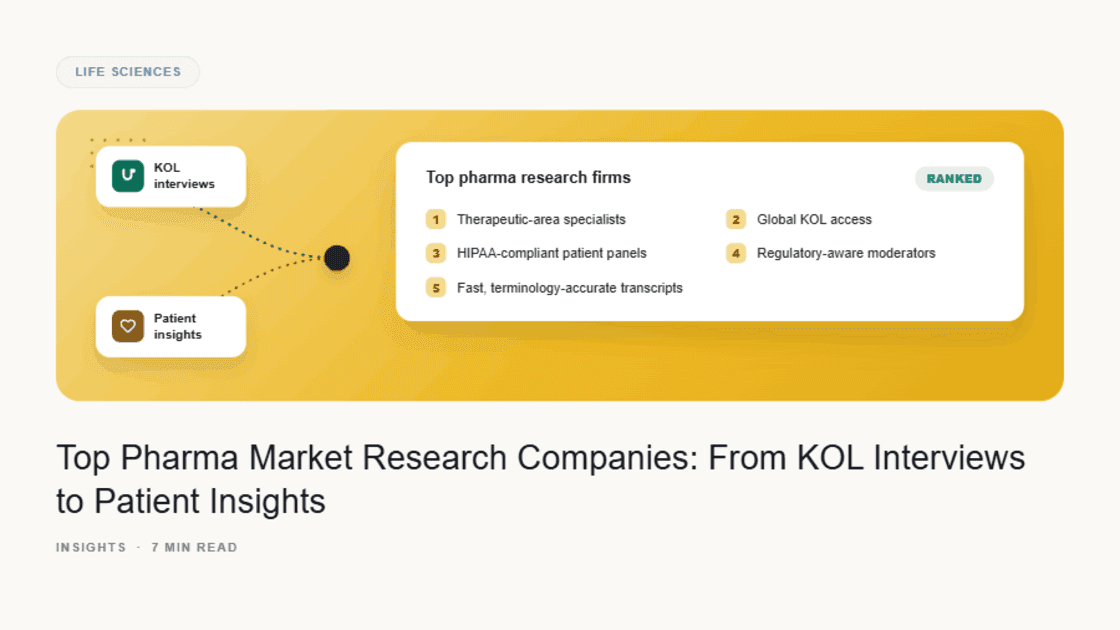
Pharmaceutical market research is its own discipline, distinct from general consumer or B2B research. The firms that do it well combine access to verified healthcare professionals, therapeutic area expertise, and compliance infrastructure that holds up under regulatory scrutiny. This post covers five MROs worth knowing, from global giants to specialist consultancies, with what each is actually built for.
The firms that serve this space well aren't just general market research agencies with healthcare clients. They're organizations that understand the language of therapeutic areas, know how to recruit hard-to-reach physician specialists and payer executives, and operate under the compliance frameworks that pharma sponsors need documented before a vendor ever receives a recording. Here are five worth knowing.
1. IQVIA
IQVIA operates at a scale that has no equivalent in healthcare market research. Founded in 1982 and headquartered in Durham, North Carolina, it employs tens of thousands of people across more than 100 countries, processing one of the largest proprietary datasets in healthcare. Fortune named it first in the Health Care: Pharmacy and Other Services category on its World's Most Admired Companies list for 2026, the ninth consecutive year.
Its Primary Intelligence service is the research arm most relevant to pharma commercial and medical affairs teams: primary interview-based research combined with IQVIA's secondary data to produce decision-ready insights. The scale of IQVIA's data infrastructure means primary research doesn't sit in isolation. KOL interview findings can be cross-referenced against prescribing behavior, real-world evidence, and competitive pipeline data in a way smaller firms simply can't replicate.
Where IQVIA earns its positioning is in large-scale, cross-portfolio programs where data depth, geographic consistency, and regulatory credibility all need to hold simultaneously. For a single-market qualitative study, it may not be the most nimble option. For a global launch readiness program spanning multiple therapeutic areas and markets, it's genuinely in a category of its own.
Best for: Global pharmaceutical companies running cross-portfolio analytics, commercial strategy research, and evidence generation programs at scale.
2. M3 Global Research
M3 Global Research operates the world's largest proprietary panel of verified healthcare professionals, covering more than 2 million physicians, nurses, pharmacists, and other HCPs across 27 countries. Part of M3 Inc., founded in 2000 and listed on the Tokyo Stock Exchange, the division holds ISO 20252 certification for market research quality and ISO 27001 certification for information security.
Its qualitative research capabilities, branded under medeConnect, have more than 15 years of experience running primary research with doctors, nurses, pharmacists, patients, KOLs, and payers. Whether that means sourcing and conducting in-depth KOL interviews in a narrow therapeutic area or designing and executing longitudinal multi-market quantitative trackers, M3's panel depth is the key differentiator. Recruiting a specific subspecialist in a market where that specialty is thin on the ground is exactly where a panel of 2 million verified HCPs earns its keep.
For pharma teams doing both qualitative and quantitative work across multiple markets, M3 offers the unusual advantage of running both under one vendor relationship rather than managing separate fieldwork and research agencies.
Best for: Pharma companies needing verified HCP access at scale for KOL interviews, payer research, and multi-market quantitative programmes.
3. Ipsos Healthcare
Ipsos operates across more than 87 countries with a deep healthcare research practice that covers the full spectrum of what pharma and medtech sponsors need: KOL research, advisory board facilitation, patient journey research, payer interviews, HEOR, market access, and non-interventional studies.
Its compliance infrastructure is worth noting specifically. Ipsos maintains in-house compliance support for pharmacovigilance, data protection, and healthcare industry codes, including EphMRA, BHBIA, and ESOMAR. For pharma sponsors who need vendor compliance documentation before routing a study, that's not a small thing. Its Global Therapy Monitors provide syndicated real-world data across therapeutic areas to support both HEOR and market access work alongside primary research programs.
The Ipsos Market Access team combines agile fieldwork with rigorous methodology, including conjoint exercises, evidence gap assessments, and payer objection mapping tied directly to launch decisions. Its KOL advisory board work has been used to directly inform commercial and regulatory strategy, with documented case studies in immunology, oncology, and rare disease.
Best for: Pharma companies needing full-service research across the product lifecycle, from pre-launch KOL landscaping to post-launch payer tracking, with documented compliance infrastructure.
4. Sprout Health Solutions
Sprout Health Solutions was founded as a specialist consultancy in patient-centered outcomes research, Sprout is built around behavioral science and health outcomes expertise, bringing together psychologists, sociologists, and medical anthropologists whose work spans COA (Clinical Outcome Assessment) strategy, qualitative patient and HCP research, and behavior change program design for pharma and biotech clients worldwide.
Its COA division, launched in 2019, focuses specifically on the selection and use of clinical outcome assessment endpoints in clinical trials, an area where the regulatory requirements of FDA and EMA demand a level of scientific rigor that general market research firms rarely have on staff. Sprout publishes in peer-reviewed journals, presents original research at scientific conferences, and engages directly with regulators on COA strategy, which means the evidence it generates holds up under the kind of scrutiny that a regulatory submission requires.
As a WBENC-certified women-owned business, Sprout also meets supplier diversity requirements for pharma companies with diversity procurement mandates, which is a practical operational consideration for global pharma procurement teams.
Best for: Pharma and biotech companies needing specialist COA strategy, patient-centered outcomes research, and qualitative research with regulatory-grade rigor.
5. Oracle Life Sciences (formerly Cerner Enviza, formerly Kantar Health)
The firm in this slot has changed names twice in four years, and the history matters for anyone working in pharma market research. Kantar's entire health division was acquired by Cerner Corporation in 2021 and rebranded as Cerner Enviza, combining Kantar Health's decades of life sciences market research expertise with Cerner's real-world data infrastructure. When Oracle subsequently acquired Cerner, Cerner Enviza moved under the Oracle Life Sciences umbrella, where it continues to operate and is now transitioning into Oracle Health.
The research capability that pharma MRO clients knew through Kantar Health, the proprietary HCP panel covering physicians, payers, nurses, KOLs, and patients across major global markets, remains intact under the Oracle Life Sciences entity. What the Oracle acquisition added is significant: Cerner's EHR network, one of the largest in the US, which means primary research now sits alongside real-world data from clinical records at a scale no standalone MRO can match. For pharma commercial and HEOR teams, that combination of primary interview-based research with longitudinal real-world evidence in a single vendor relationship is genuinely differentiated from what most standalone MROs can offer.
Current services under Oracle Life Sciences include patient journey analytics, brand health tracking, custom primary research, market access and health economics support, syndicated studies across major therapy areas, and real-world evidence generation. The entity continues to serve global life sciences companies across oncology, rare disease, and broad therapeutic areas.
Best for: Pharma companies needing integrated primary research and real-world evidence from a single vendor, particularly for launch strategy, HEOR, and market access programmes where primary insights and RWD need to speak to each other.
What These MROs Have in Common
All five operate under documented compliance frameworks appropriate for pharma-sponsored research. All five have experience with the specific research formats that define this space: KOL interviews, advisory board facilitation, payer research, patient insight studies, and longitudinal tracking. And all five understand that the output of their work feeds into decisions with regulatory, commercial, and clinical consequences, which is a different standard than most market research contexts require.
For pharma teams working with any of these organizations, one consistent operational reality applies: the recordings from KOL interviews, advisory boards, patient focus groups, and physician IDIs need to be transcribed accurately, confidentially, and under the compliance frameworks that govern the data. That means HIPAA for US-based health research, GDPR for EU participants, PIPEDA for Canadian studies, and APPI for Japan-based pharma research. At Qualtranscribe, that compliance coverage is standard across every project, with NDA-bound transcriptionists, encrypted file transfer, regional data storage, and recordings that are never used to train AI models.
Need accurate, compliant transcription for pharma market research sessions? Get started here.
FAQ
What is an MRO in pharma market research? A Market Research Organization (MRO) is a firm that designs and executes primary market research for pharmaceutical, biotech, and medtech clients. MROs are distinct from CROs (Contract Research Organizations), which manage clinical trials. MROs handle commercial and insights research: KOL interviews, payer studies, patient advisory boards, physician surveys, and product concept testing.
What is KOL research in pharma? Key Opinion Leader (KOL) research involves in-depth interviews or advisory board sessions with leading physicians, scientists, or clinical specialists in a therapeutic area. Pharma companies use KOL insights to inform clinical trial design, commercial strategy, medical affairs positioning, and regulatory submissions.
How do pharma companies choose an MRO? Selection criteria typically include therapeutic area experience, geographic reach, HCP panel quality, compliance documentation (HIPAA, GDPR, EphMRA), turnaround time, and the specific methodology required, whether qualitative, quantitative, or both. For global programs, the ability to maintain research consistency across markets matters significantly.
What compliance frameworks apply to pharma market research? In the US, research involving protected health information requires HIPAA compliance. Research involving EU participants falls under GDPR. Canadian studies require PIPEDA compliance. Japan-based pharma research, particularly for regulatory submissions, requires APPI compliance. Most reputable MROs also adhere to EphMRA, BHBIA, and ESOMAR codes of conduct.
Why does transcript accuracy matter in pharma market research? KOL interviews and advisory board sessions produce findings that can directly influence regulatory submissions, commercial strategy, and medical affairs positioning. A misquoted KOL comment or an inaccurate payer research transcript isn't just an analytical inconvenience. It's a strategic decision built on bad data. Verbatim accuracy, under proper compliance documentation, is what makes the research defensible.
Related Reading
Turn your recordings into analysis-ready transcripts.
Human Transcription
Clean verbatim and full verbatim transcripts, delivered by specialist transcriptionists
AI Transcription
Instant Draft powered by AI, with Smart Insights for analysis-ready output
Translation Services
Accurate translation across 99+ languages for multilingual research workflows
Keep reading
Related articles

How to Write a Transcription Data Management Plan for IRB Submission
Most IRB protocols get sent back for revision on the data security and management sections, and within those sections, transcription is the specific area where protocols most frequently fall short. The reasons are consistent: researchers describe their interview methodology in careful detail, specify their analysis software, and then write a single sentence about transcription that doesn't address who's doing it, what compliance standards the vendor meets, how files will be transferred, where they'll be stored, or when they'll be deleted.
Read article

Spanish Transcription for US Hispanic Research: Dialects, Generations, and What to Expect
A common setup in community-based Latino health research: bilingual interviews with first, second, and 1.5-generation participants, conducted in English or Spanish depending on each participant's preference, at community organizations across a Midwestern city. The recordings come back mixed. Some are fully in Spanish, some fully in English, some switching mid-interview as participants reach for the language that fits the concept they're describing. One transcriptionist flags the mixed recordings as too difficult. Another delivers transcripts where heritage speaker constructions have been silently corrected to standard Spanish. The researcher is now reviewing every transcript manually before analysis can begin. This is the predictable result of sending US Hispanic research recordings, whether from one-on-one interviews, focus groups, or Zoom, Teams, and Webex sessions, to transcription services built for standard, monolingual speech.
Read article

The Best Transcription Services for Focus Groups in 2026
Focus groups generate some of the most demanding audio in qualitative research. Six to twelve people talking, sometimes over each other, sometimes in a room with bad acoustics, sometimes over a Zoom call with background noise from a home environment. Getting that audio into a clean, usable transcript is where a lot of research budgets and timelines get tested. Not every transcription service handles this well, and the right one often depends on the kind of focus group you're actually running.
Read article

© 2026 Qualtranscribe LLC. Services Provided Globally