
•
11 mins
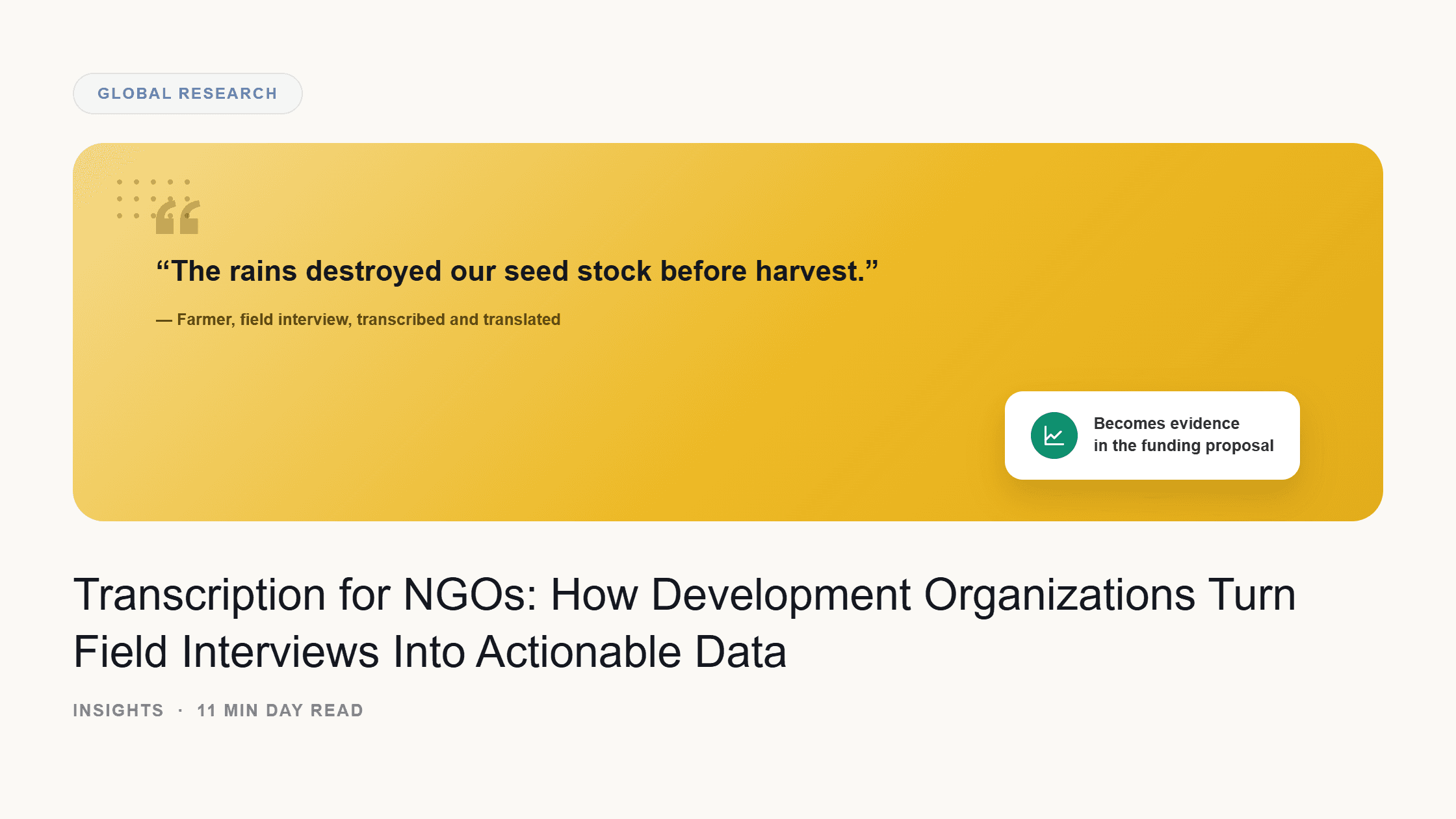
A development organization running a program evaluation across three countries in two languages generates hundreds of hours of beneficiary interviews, focus group discussions, and community feedback sessions. Raw audio is unsearchable, uncitable, and impossible to hand to a donor. Transcription is the step that converts it into structured evidence. This post covers why that step matters operationally for MEL teams and grant managers, what makes field audio hard to transcribe accurately, a five-step workflow from recording to donor report, and what to look for in a transcription partner for development work.
The Audio Bottleneck in Fieldwork
An evaluation team supporting a nutrition program in rural Kenya and coastal Tanzania wraps up six weeks of community interviews. The field coordinator returns with 180 hours of audio across four languages, recorded in village halls, community health centers, and outdoor market spaces. The program director has a donor report due in three weeks.
The audio sits on a laptop.
This is the audio bottleneck: the gap between rich qualitative data collected in the field and structured evidence that a donor, policy team, or MEL officer can actually use. Development organizations invest significant budgets in fieldwork, in recruitment, travel, local staff, community engagement, and recording equipment. The recordings themselves are often the most complete picture of program impact that exists. But raw audio is dark data. It cannot be searched, systematically coded, directly cited, or handed to anyone who wasn't in the room.
Transcription is not an administrative afterthought in this picture. It is what turns recorded voices into something a donor can verify, a coder can analyze, and a policy team can act on.
Why Transcription Matters Specifically for NGO Work
The operational stakes of accurate transcription look different in development contexts than they do in academic or commercial research. Four outcomes drive why MEL officers and program leads should treat transcription as a core part of the fieldwork budget, not a post-project cleanup task.
Monitoring, Evaluation, and Learning (MEL). Written transcripts allow M&E teams to code qualitative data systematically across regions and time periods. Themes that emerge in interviews in Senegal can be compared directly with themes from interviews in Bangladesh when both are in structured text form. Without transcripts, cross-regional qualitative comparison depends on field coordinator memories and handwritten notes, which is not a methodology that survives scrutiny in a rigorous evaluation.
Donor accountability and verification. The European Commission, the Gates Foundation, FCDO, and UN agencies all expect qualitative evidence in program evaluations to be verifiable. Verbatim transcripts are what make beneficiary quotes verifiable. A quote in a donor report attributed to "a community member in Region X" is far stronger when the underlying transcript exists, speaker-labeled and timestamped, than when it exists only as a note taken by a field coordinator who has since moved to another organization.
Ethical representation of beneficiary voice. Development research involves communities whose experiences are being documented, often by outsiders with significant power differentials. Hasty paraphrase, even well-intentioned, introduces researcher bias. Verbatim transcription, done accurately and with cultural sensitivity, preserves exactly what participants said in their own words. Getting it right matters both for the integrity of the research and for the people who gave their time to participate.
Knowledge management and longitudinal analysis. A searchable archive of transcribed fieldwork interviews has value beyond the original evaluation. Future project teams can re-analyze prior data for longitudinal comparisons. Advocacy teams can pull specific community voices for policy briefs. Communications teams can use authentic beneficiary language in reports and campaigns. All of it requires text. Audio files sitting on a shared drive produce none of it.
The Real Challenges of Field Audio in Development Work
Field audio is some of the hardest audio to transcribe accurately. General-purpose transcription tools are built for controlled conditions. NGO fieldwork doesn't produce controlled conditions. Focus group discussions in particular, with 8 to 15 simultaneous speakers, are where most automated tools fall furthest short.
Challenge | Impact on Transcription | Practical Response |
|---|---|---|
Environmental noise | Outdoor wind, market background noise, poor room acoustics reduce accuracy on any automated tool | Directional microphones where possible; flag poor-quality files for human transcription rather than AI |
Multilingual and code-switching | Participants switch between languages mid-sentence, regional dialects differ significantly from standard language training data | Native human transcribers matched to regional variety; not general AI models |
Indigenous and minority languages | Many languages used in development fieldwork have little or no AI training data | Human-only transcription; specialist transcriptionists familiar with the specific language |
Sensitive content | GBV disclosures, conflict-related testimony, political opinions in restrictive environments | De-identification before transcripts leave the secure research environment; NDA-bound transcriptionists |
Multiple speakers | Group discussions, FGDs, and community meetings with 8-15 simultaneous speakers | Human transcription with consistent speaker labeling; AI diarization is unreliable at this scale |
The Five-Step Workflow: From Field Recording to Actionable Data
Step 1: Standardized capture Before fieldwork begins, establish recording standards. Define file naming conventions and apply them consistently: [Date]_[Site]_[Language]_[SessionType] (for example, 20260615_Nairobi_Swahili_FGD01). Ensure all devices are set to the same audio quality settings, document consent alongside the recording metadata, and brief field teams on microphone placement. Recordings where the field coordinator is too far from the microphone produce audio that is technically recoverable but expensive to transcribe accurately. Ten minutes of briefing before the first session prevents hours of recovery afterward.
Step 2: Transcription and translation The decision between source-language transcription and direct translation should be made before fieldwork starts, not after. Source-language transcription (Swahili to Swahili text, for example) is the right choice when linguistic analysis, discourse patterns, or original language are analytically significant, or when the organization needs both language versions for archival and reporting purposes. Direct translation transcription (Swahili audio to English text in a single pass by a bilingual transcriptionist) is faster and cheaper and works well when English is the required output language and the original language text isn't needed for analysis.
For budget-constrained grant managers, the cost difference is significant. A two-step process, transcribe to source language first, then translate to English separately, typically costs 30 to 40 percent more in both fees and turnaround time than direct translation in a single pass. For a program evaluation running 40 interviews across two languages, that difference can amount to several weeks of timeline compression and meaningful budget savings that can be reallocated to fieldwork or analysis.
For a Gates Foundation-funded nutrition program running community interviews in rural Guatemala, the same decision applies: direct Spanish-to-English transcription at $6.00 per minute is faster and cheaper than transcribing to Spanish first and translating separately, unless the team needs the original Spanish for linguistic analysis or in-country reporting to local stakeholders. For multilingual fieldwork, Qualtranscribe supports both workflows across 25 languages for human transcription.
Step 3: Anonymization and cleaning De-identification should happen before transcripts circulate beyond the immediate research team, particularly for fieldwork involving vulnerable populations. Replace participant names with standardized codes: [B01], [B02] for individual beneficiaries, [FGD01] for focus group discussions, [KI01] for key informants. Generalize geographic identifiers below district level where identification risk is high. Flag and redact references to identifiable third parties mentioned incidentally during interviews. For GBV research, conflict-related testimony, or work with undocumented populations, apply HIPAA Safe Harbor standards even when not technically required, since the protection they provide is appropriate to the sensitivity of the content. Qualtranscribe's healthcare research transcription framework covers these standards as standard practice.
Step 4: Thematic coding and qualitative analysis Formatted transcripts import directly into NVivo, ATLAS.ti, MAXQDA, and Dedoose for systematic thematic coding. Qualtranscribe delivers transcripts in research-ready formats including NVivo Synchronized (audio-linked timestamps for playback during coding), NVivo Headings (auto-coding by question or topic), NVivo Basic (clean import without linked audio), and .docx or .srt formats for other QDA platforms. Consistent speaker labeling across all transcripts in a dataset means you can code by participant type (beneficiary, community leader, field staff) as well as by theme. Transcripts that arrive without consistent formatting, or with speaker labels that vary across files, require manual standardization before coding can begin.
Step 5: Synthesis and reporting The end product of this workflow is structured qualitative evidence that can be combined with quantitative program data in donor reports, policy briefs, and advocacy materials. Direct beneficiary quotes pulled from verbatim transcripts carry more weight than paraphrased summaries. USAID's MEL policy guidance and similar frameworks from the European Commission and UN agencies increasingly expect qualitative evidence to be traceable to its source. A transcript with a speaker label and timestamp is traceable. A field note isn't.
Human vs AI vs Hybrid: Which Fits NGO Fieldwork
All three approaches have a legitimate place in development research transcription workflows. The choice depends on audio quality, language, content sensitivity, and what the output will be used for.
Automated AI transcription works well for clear audio, single speakers, standard languages with large training datasets (English, Spanish, French, standard Arabic), and situations where speed matters more than precision. For a quick first read of an interview conducted in a quiet room in English, AI transcription is fast and cost-effective. For field recordings in regional dialects of Hausa or Wolof, with background noise and multiple overlapping speakers, it is not reliable enough for evidence-based reporting.
Human professional transcription is slower and costs more per minute, but produces meaningfully more accurate output on the conditions that define most NGO fieldwork: environmental noise, accented speech, code-switching, technical terminology, and multi-speaker group discussions. For donor reports, evaluations, and any transcript that will be quoted or cited, human transcription is the defensible choice.
The hybrid approach uses AI transcription for a rapid first draft, followed by human review and correction. For large-volume projects where cost is a constraint and audio quality is reasonable, this can be the most efficient path. The AI draft is never the final product for sensitive content or formal reporting.
Qualtranscribe's Instant Draft handles the AI side, with Smart Insights surfacing themes automatically across sessions. Human transcription handles the sessions where accuracy is non-negotiable. Both run under the same compliance framework: HIPAA, GDPR, PIPEDA, and APPI compliance as standard, NDA-bound transcriptionists, encrypted file transfer, and zero AI training on uploaded recordings.
What to Look for in a Transcription Partner for Development Work
Language range matched to your fieldwork geography. A partner who supports English, French, and Spanish isn't enough for most international development work. Swahili, Amharic, Arabic, French, Spanish, and Portuguese cover a significant portion of development fieldwork geography, but your specific countries of operation may require other languages. Confirm before you commit.
Dialect and regional matching. The Amharic spoken in Addis Ababa differs from Amharic in rural Oromia. The French spoken in Senegal differs from the French spoken in DRC. A transcriptionist matched to the specific regional variety in your recordings produces more accurate output than one matched only to the standard form of the language.
Compliance appropriate to your funder and IRB. Historically, USAID-funded research required IRB approval and specific data handling standards. EU-funded research involving participants in EU member states is subject to GDPR. Research involving vulnerable populations anywhere may require HIPAA-equivalent data handling regardless of whether it's technically mandated. Confirm that your transcription partner can provide NDAs, data processing agreements, and a defined file deletion timeline before submitting any recordings. See Qualtranscribe's security framework for the specific controls in place.
Turnaround that fits your reporting cycle. Rolling delivery, transcripts delivered as sessions are completed rather than batched at the end of fieldwork, means analysis can begin before field data collection ends. For organizations running evaluations against fixed donor reporting deadlines, this is the difference between adequate analysis time and a rushed synthesis.
Direct translation capability. For organizations that need English output from fieldwork conducted in other languages, a partner who offers direct translation transcription in a single pass produces cleaner results than one who transcribes first and translates separately as a second step.
Practical Checklist for NGO Fieldwork Transcription
Before fieldwork:
Define file naming conventions and brief field teams before the first session
Decide between source-language and direct translation transcription before recordings are made
Confirm transcription vendor compliance documentation (NDA, DPA, deletion policy) before any files are transferred
Establish de-identification protocols for participant codes and geographic generalization
During fieldwork:
Upload recordings to your transcription service on a rolling basis rather than batching at the end
Flag any recordings with significant background noise or audio quality issues so they can be routed to human transcription
Document consent alongside recording metadata
After transcription:
Verify a random sample of transcripts against original audio before beginning systematic coding
Confirm speaker labels are consistent across all files in the dataset before importing to qualitative software
Delete raw audio files from field devices once transcripts are verified and securely stored
Need accurate, compliant transcription for your next development fieldwork project? Get started here.
FAQ
What languages does Qualtranscribe support for NGO fieldwork transcription? Human transcription is available in 25 languages, including Swahili, Amharic, French, Arabic, Spanish, Portuguese, and others commonly used in development fieldwork. AI transcription via Instant Draft covers 99+ languages. Confirm the specific languages and dialects for your project before committing.
How should we handle recordings involving GBV survivors or conflict-affected communities? Apply de-identification before transcripts leave the immediate research team. Replace all participant identifiers with codes. Generalize geographic identifiers below district level. Use a transcription service with NDA-bound transcriptionists and encrypted file transfer. Confirm that the vendor's data handling meets your IRB or ethical review requirements before submitting any recordings.
Can AI transcription be used for MEL and donor reporting? For a preliminary thematic read, yes. For transcripts that will be quoted in donor reports or cited in evaluations, human transcription is the appropriate standard. Donors and auditors who request to see underlying evidence for qualitative quotes need transcripts that are accurate enough to be verified against the original recording.
What format should transcripts be in for NVivo or MAXQDA import? Speaker labels applied consistently throughout the file, timestamps at regular intervals, and paragraph breaks at each speaker turn. Qualtranscribe delivers NVivo Synchronized, NVivo Headings, NVivo Basic, ATLAS.ti, MAXQDA, and Dedoose-compatible formatting as standard.
How do we handle multilingual focus groups where participants speak different languages? Assign a bilingual transcriptionist fluent in both languages to the session. Request that language transitions be clearly marked in the transcript (e.g., [Swahili] and [English] tags). If both language versions are needed, source-language transcription with a separate English translation is the most defensible option for formal reporting.
Related Reading
Transcribing and Translating African Languages: Challenges and Solutions
Spanish Transcription and Translation: From Fieldwork to Findings
How Transcription Services Support Academic Research and Fieldwork
De-identification, Anonymization, and Pseudonymization: What's the Difference
Why Market Research Dies in the Room: The Case for Recording and Transcribing Every Interview
Turn your recordings into analysis-ready transcripts.
Human Transcription
Clean verbatim and full verbatim transcripts, delivered by specialist transcriptionists
AI Transcription
Instant Draft powered by AI, with Smart Insights for analysis-ready output
Translation Services
Accurate translation across 99+ languages for multilingual research workflows
Keep reading
Related articles

Portuguese Transcription in Latin American Field Research: A Practical Guide
A research team returns from fieldwork across São Paulo, Recife, and Porto Alegre. Three cities, three clearly distinct accents, two weeks of interviews. Back at the institution, someone books a Portuguese transcriptionist. Nobody specifies which variety of Portuguese they need. The transcripts come back with Nordestino expressions normalized to São Paulo usage, a participant whose name appears in three different spellings, and no timestamps. Technically, the words are mostly right. As research data, the transcripts are close to unusable. This happens because transcription for field research in Brazil requires decisions that general transcription services don't prompt researchers to make.
Read article

How to Turn a 60-Minute Webex Recording into a 2-Minute Read
Picture this: someone drops a Webex link in your inbox with a note saying the answer to your question is "somewhere in the recording." Or you ran a 60-minute KOL interview three days ago, need to quote it accurately in a briefing, and your memory of what was said is already fuzzing at the edges.
Read article

Transcription for Contract Research Organizations: What CROs Actually Need
A CRO managing a Phase III oncology trial across eight countries has forty investigator site initiation meetings recorded over six weeks, three patient advisory board sessions, fifteen KOL interviews, and a pharmacovigilance team fielding adverse event reports from site calls. Every one of those recordings needs to become a document. The question is what kind, under what compliance standard, and how fast. The answer is different for each recording type, and the difference matters in ways that show up in regulatory audits, sponsor deliverables, and safety reporting timelines. Generic transcription tools fail here not because they produce inaccurate text, though they often do, but because they were built for a different problem. A CRO's transcription requirements are a compliance problem as much as a documentation problem.
Read article
© 2026 Qualtranscribe LLC. Services Provided Globally