
Language & Culture
Practical transcription, research, and language insights
Explore live articles from the CMS, including security, market research, language support, and transcription workflows.

All articles
Newest CMS entries appear first automatically.
Category
All
Language & Culture
Perspectives
How-to Guides & Tutorials
Market Research & Business
Privacy & Confidentiality
Global Translation & Localization
Qualitative Research & Academia
Speech Recognition with AI

How to Write a Transcription Data Management Plan for IRB Submission
Most IRB protocols get sent back for revision on the data security and management sections, and within those sections, transcription is the specific area where protocols most frequently fall short. The reasons are consistent: researchers describe their interview methodology in careful detail, specify their analysis software, and then write a single sentence about transcription that doesn't address who's doing it, what compliance standards the vendor meets, how files will be transferred, where they'll be stored, or when they'll be deleted.
Read article

Spanish Transcription for US Hispanic Research: Dialects, Generations, and What to Expect
A common setup in community-based Latino health research: bilingual interviews with first, second, and 1.5-generation participants, conducted in English or Spanish depending on each participant's preference, at community organizations across a Midwestern city. The recordings come back mixed. Some are fully in Spanish, some fully in English, some switching mid-interview as participants reach for the language that fits the concept they're describing. One transcriptionist flags the mixed recordings as too difficult. Another delivers transcripts where heritage speaker constructions have been silently corrected to standard Spanish. The researcher is now reviewing every transcript manually before analysis can begin. This is the predictable result of sending US Hispanic research recordings, whether from one-on-one interviews, focus groups, or Zoom, Teams, and Webex sessions, to transcription services built for standard, monolingual speech.
Read article

The Best Transcription Services for Focus Groups in 2026
Focus groups generate some of the most demanding audio in qualitative research. Six to twelve people talking, sometimes over each other, sometimes in a room with bad acoustics, sometimes over a Zoom call with background noise from a home environment. Getting that audio into a clean, usable transcript is where a lot of research budgets and timelines get tested. Not every transcription service handles this well, and the right one often depends on the kind of focus group you're actually running.
Read article

Portuguese Transcription in Latin American Field Research: A Practical Guide
A research team returns from fieldwork across São Paulo, Recife, and Porto Alegre. Three cities, three clearly distinct accents, two weeks of interviews. Back at the institution, someone books a Portuguese transcriptionist. Nobody specifies which variety of Portuguese they need. The transcripts come back with Nordestino expressions normalized to São Paulo usage, a participant whose name appears in three different spellings, and no timestamps. Technically, the words are mostly right. As research data, the transcripts are close to unusable. This happens because transcription for field research in Brazil requires decisions that general transcription services don't prompt researchers to make.
Read article

How to Turn a 60-Minute Webex Recording into a 2-Minute Read
Picture this: someone drops a Webex link in your inbox with a note saying the answer to your question is "somewhere in the recording." Or you ran a 60-minute KOL interview three days ago, need to quote it accurately in a briefing, and your memory of what was said is already fuzzing at the edges.
Read article

Transcription for Contract Research Organizations: What CROs Actually Need
A CRO managing a Phase III oncology trial across eight countries has forty investigator site initiation meetings recorded over six weeks, three patient advisory board sessions, fifteen KOL interviews, and a pharmacovigilance team fielding adverse event reports from site calls. Every one of those recordings needs to become a document. The question is what kind, under what compliance standard, and how fast. The answer is different for each recording type, and the difference matters in ways that show up in regulatory audits, sponsor deliverables, and safety reporting timelines. Generic transcription tools fail here not because they produce inaccurate text, though they often do, but because they were built for a different problem. A CRO's transcription requirements are a compliance problem as much as a documentation problem.
Read article

How to Transcribe KOL Interviews for Medical Affairs and Market Access Teams
A medical affairs team finishes 15 KOL interviews across three therapeutic areas. The insights will inform launch strategy, formulary positioning, and a regulatory briefing. The audio sits in a shared folder. Nobody has agreed on a transcription workflow, which verbatim style, which compliance documentation, whether the service has the therapeutic area familiarity to handle what was actually said in those recordings. This is the gap that creates problems downstream. And it's entirely preventable.
Read article
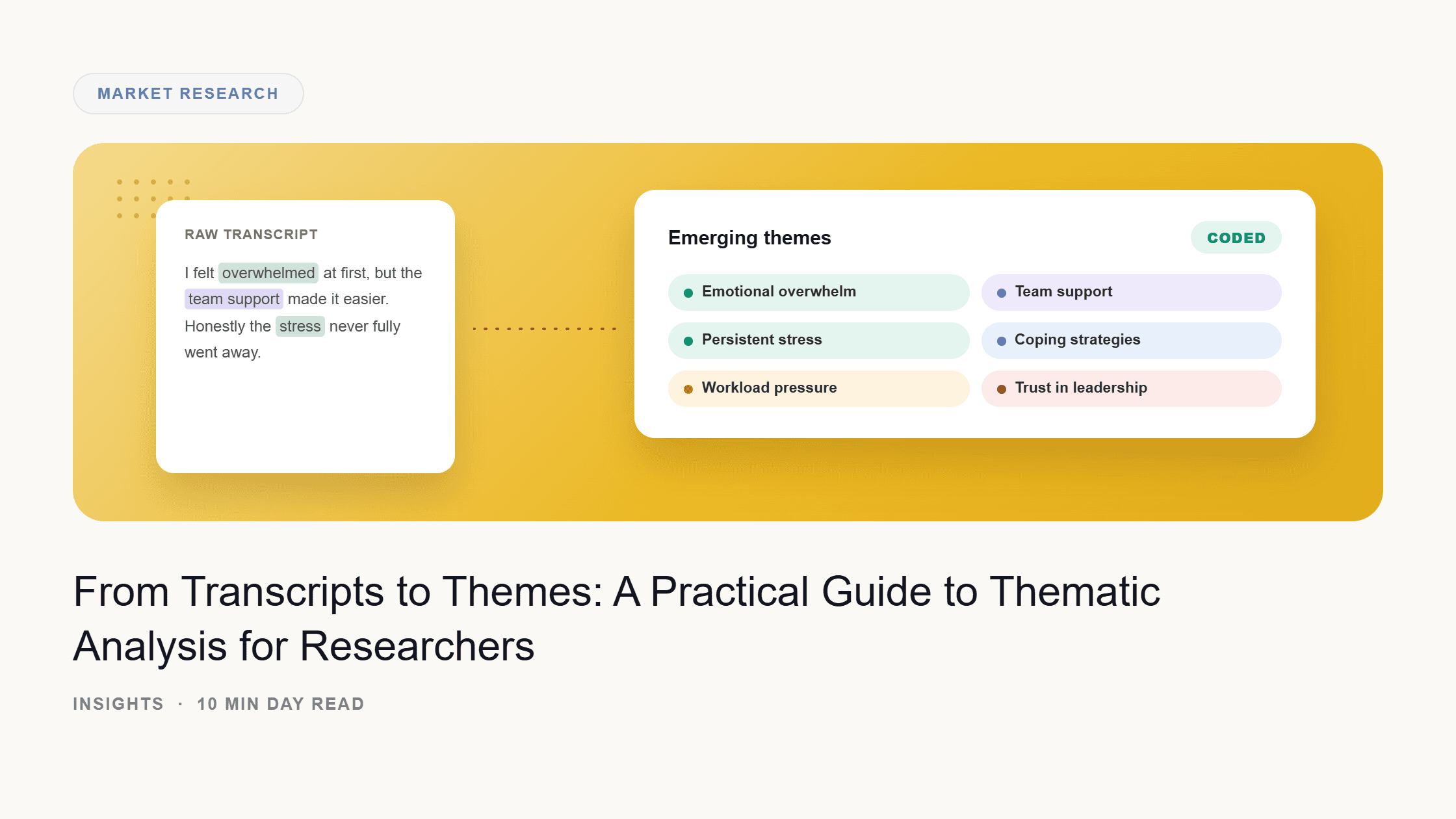
From Transcripts to Themes: A Practical Guide to Thematic Analysis for Researchers
A researcher with 25 interviews and a blank NVivo project is not lacking a definition of thematic analysis. What they're looking for is what to do next, in what order, and how to know when they're doing it well. That's what this guide covers.
Read article

GDPR-Compliant German Transcription: What EU Research Teams Need to Know
GDPR has issued over €7.1 billion in cumulative fines since 2018, with €1.2 billion issued in 2025 alone, according to the DLA Piper GDPR Fines and Data Breach Survey published in January 2026. Enforcement is active, consistent, and specifically focused on data processing practices that research institutions treat as routine. Using a transcription service without a Data Processing Agreement in place, routing recordings through servers outside the EU without appropriate safeguards, or failing to specify retention and deletion timelines for audio files are all compliance failures that regulators have acted on. For German research teams, this isn't a future risk. It's an active one.
Read article
Language & Culture
View all
Perspectives
View all
How-to Guides & Tutorials
View all

How to Conduct a Focus Group on Microsoft Teams: A Complete Guide
Microsoft Teams has become the default video platform for a large part of the research world, particularly in institutions, hospitals, pharmaceutical companies, and universities where Microsoft 365 is already standard. If your participants are already using Teams for their day-to-day work, running a focus group on Teams reduces friction significantly. They don't need to download anything new or create a new account.
Read article

How to Conduct a Focus Group on Zoom: A Complete Guide
Zoom has become the default platform for virtual focus groups, and for good reason. Participants already know how to use it. It handles groups of six to twelve comfortably. Breakout rooms let you run sub-group exercises. And the recording quality, on good internet with decent microphones, is good enough for professional transcription. But running a focus group on Zoom is not the same as running a standard meeting on Zoom. The setup decisions that don't matter for a team standup matter a lot when you need accurate speaker attribution, clean audio for six participants talking over each other, and a recording that will be professionally transcribed for qualitative analysis. This guide covers every step
Read article

How to Write a Focus Group Discussion Guide
A bad discussion guide is one of the most expensive mistakes in qualitative research, and it's invisible until the session is already over. The moderator gets through every question, the recording is clean, and the transcript is perfect. Then someone tries to analyze it and realizes the answers are all shallow, the best questions came too early before participants were warmed up, and the one thing the client actually needed to know never got asked because the guide ran out of time.
Read article
Market Research & Business
View all
Transcription for Contract Research Organizations: What CROs Actually Need
A CRO managing a Phase III oncology trial across eight countries has forty investigator site initiation meetings recorded over six weeks, three patient advisory board sessions, fifteen KOL interviews, and a pharmacovigilance team fielding adverse event reports from site calls. Every one of those recordings needs to become a document. The question is what kind, under what compliance standard, and how fast. The answer is different for each recording type, and the difference matters in ways that show up in regulatory audits, sponsor deliverables, and safety reporting timelines. Generic transcription tools fail here not because they produce inaccurate text, though they often do, but because they were built for a different problem. A CRO's transcription requirements are a compliance problem as much as a documentation problem.
Read article
How to Transcribe KOL Interviews for Medical Affairs and Market Access Teams
A medical affairs team finishes 15 KOL interviews across three therapeutic areas. The insights will inform launch strategy, formulary positioning, and a regulatory briefing. The audio sits in a shared folder. Nobody has agreed on a transcription workflow, which verbatim style, which compliance documentation, whether the service has the therapeutic area familiarity to handle what was actually said in those recordings. This is the gap that creates problems downstream. And it's entirely preventable.
Read article
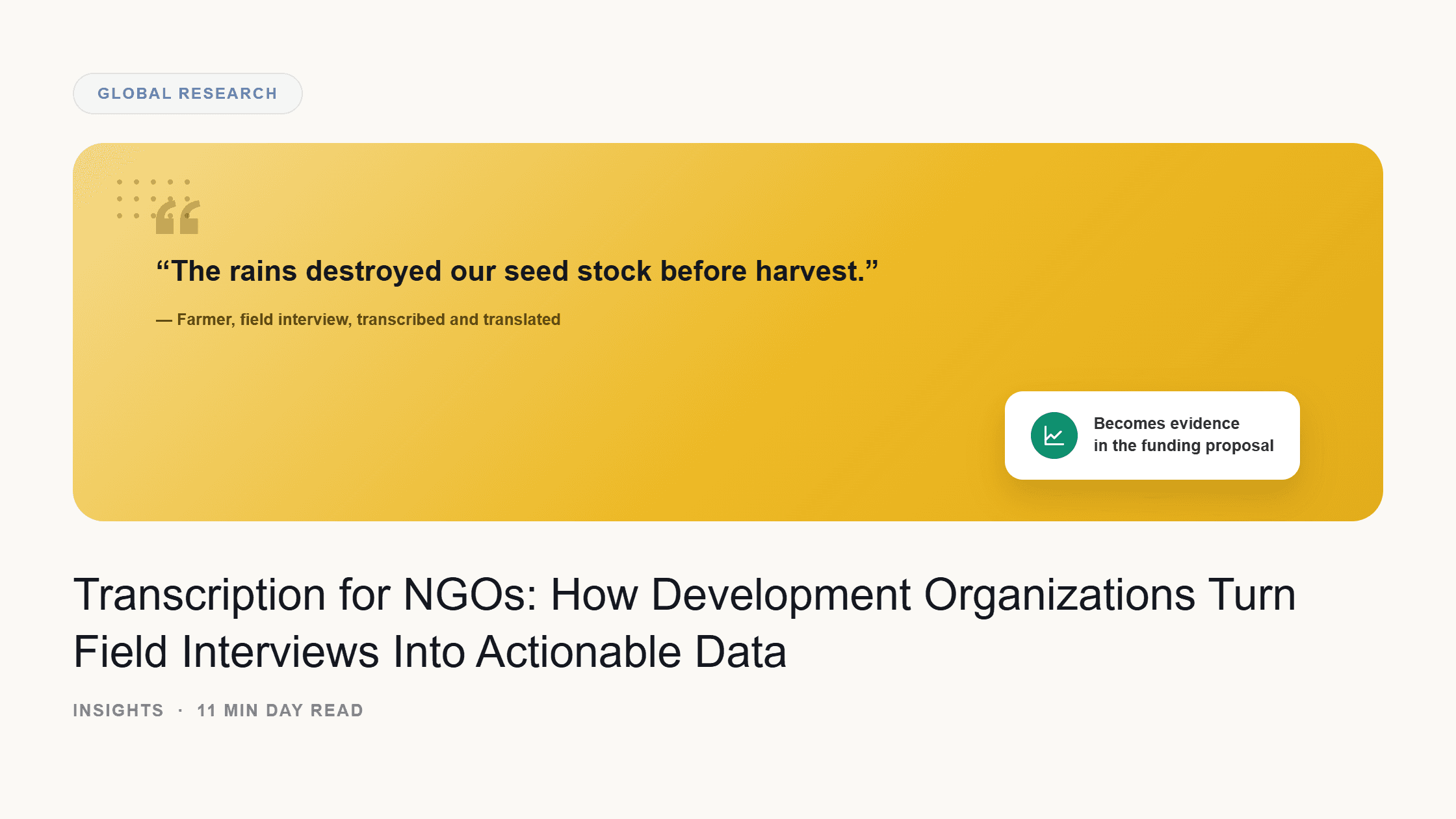
Transcription for NGOs: How Development Organizations Turn Field Interviews Into Actionable Data
Development organizations spend months designing studies, recruiting participants, training field teams, and traveling to remote communities to collect qualitative data. The recordings that come back from that work are often the richest, most direct evidence of program impact that exists. They contain beneficiary voices in their own words, unprompted observations about what's working and what isn't, and context that no survey instrument can capture. Then those recordings sit on a laptop while the donor report deadline approaches and nobody has figured out what to do with them. Transcription is the step that most development organizations treat as an afterthought and then scramble to fix at the end of a project. This post makes the case for treating it as infrastructure instead.
Read article
Privacy & Confidentiality
View all

The Five Transcription Mistakes That Haunt Researchers at 3 AM
You are six months into your dissertation. Forty interviews completed. Your IRB protocol is solid, or so you thought. Then a committee member asks one question: "Who transcribed these interviews, and how did they access the files?" Your stomach drops. You uploaded everything to a freelancer you found online. No NDA. No security clearance. No idea what just happened to your participants' confidential healthcare stories. This happens more often than anyone wants to admit. Transcription lives in the shadow of research design — necessary enough to need, easy enough to overlook until it becomes a real problem. Here are the five mistakes that derail research projects.
Read article

What the EU AI Act Means for Researchers Who Use AI Transcription
Over the past few years, AI transcription has become a routine part of qualitative research. Researchers upload interview recordings, receive transcripts within minutes, and move directly to analysis. The time savings are real. For teams managing dozens of interviews across multiple languages, AI transcription for research interviews can significantly reduce turnaround without compromising the depth of the analytical work that follows.
Read article

De-Identification vs. Anonymization vs. Pseudonymization
A research team finishes a qualitative study, removes participant names from their transcripts, and considers the data protected. They publish findings, share transcripts with collaborators, and deposit data in an academic repository. What they didn't account for is that one participant mentioned being the only female cardiologist at a rural hospital in a specific county. The name is gone but the person is not, and anyone familiar with that county's medical community could identify her from the transcript alone.
Read article
Global Translation & Localization
View all

Your Participants Don't Speak English. Your Transcription Shouldn't Either.
A research team recruits participants in São Paulo, Lagos, Tokyo, and Warsaw. The interview guide is translated into four languages. The fieldwork team spans three time zones. The recordings come back in good condition. Then the team tries to transcribe everything and finds that most of the tools available were calibrated for English speakers in a quiet room. This is a consistent gap in global qualitative research. The methodology is rigorous and the fieldwork is thorough, but the transcription workflow can quietly disadvantage every participant who isn't a native English speaker. Most researchers don't catch it until analysis is already underway.
Read article

From Yen to Words: A Clear Look at Japanese Translation Pricing
Japanese is one of the most requested languages in professional translation and one of the most consistently misunderstood when it comes to pricing. Clients who have commissioned Spanish or French work before are often surprised by Japanese quotes. The gap is not arbitrary. It reflects real structural differences in how the language works and what accurate translation actually requires.This guide explains how Japanese translation pricing is calculated, what drives costs up or down, and what to expect before you request a quote.
Read article

Your Guide to Amharic Language Support for Social Science and Public Health Research
Fieldwork in Ethiopia produces some of the richest qualitative data in global public health and social science research. Community health interviews in Addis Ababa. Focus groups with rural participants in Amhara or Tigray. Patient experience narratives from healthcare settings in Gondar. Diaspora interviews conducted in London, Washington DC, or Minneapolis.What these projects have in common is that the data is only as good as the transcription. And Amharic transcription is genuinely difficult to do well.This guide covers why, what it requires, and how to approach it.
Read article
Qualitative Research & Academia
View all

Oral History Transcription: How to Preserve Community Voices Accurately
Oral history gives voice to people and communities whose experiences rarely make it into official records. An elder describing a neighborhood before it was demolished. A civil rights witness recounting what she saw. A craftsperson explaining a technique that has never been written down. These recordings are primary sources. How they get transcribed determines whether they survive intact as historical record or get quietly reshaped by someone else's sense of how people should speak on the page. The stakes are different here from market research or academic interview data. A poorly formatted research transcript wastes coding time. A poorly transcribed oral history misrepresents a person's voice to anyone who reads it for the next hundred years.
Read article

Top 7 Dissertation Transcription Services for Graduate Researchers
A 20-interview dissertation means up to 180 hours of manual transcription before analysis can begin. Here are seven services that convert that time back into research time, starting with the one built specifically for qualitative researchers.
Read article

How New Scholars Are Using AI in Qualitative Research: Lessons from Grodal and Schildt
A YouTube conversation between two qualitative research scholars deserves more attention than it has received. Stine Grodal, Distinguished Professor of Entrepreneurship and Innovation at Northeastern University, and Henri Schildt, Professor at Aalto University School of Business, sat down for a refreshingly honest discussion about AI and what it actually means for qualitative research. No buzzwords, no panic. Two scholars thinking carefully about a question researchers everywhere are working through: what does this change about my work? The conversation, titled Using AI in Qualitative Research and hosted by New Scholars on YouTube, is worth watching in full. What follows is an account of what stood out, what Grodal and Schildt get right, and where the conversation opens up further.
Read article
Speech Recognition with AI
View all

The Best AI Transcription Plan for Qualitative Researchers in 2026
Hours of recorded interviews, focus groups, and field studies all need to become clean, searchable text before analysis can start. A 60-minute interview that used to take six hours to transcribe manually now comes back in minutes. For researchers, that changes what's possible between fieldwork and reporting. But the tools that enable this weren't all designed with research workflows in mind, and picking the wrong one creates compliance problems that show up at the worst possible moment.
Read article

The 5 Best AI Transcription Tools for Focus Groups and Market Research in 2026
Focus groups are the hardest format to transcribe, and not just because the audio is often difficult. Six to ten people talk over each other for ninety minutes, the moderator probes in three directions at once, participants respond to each other rather than taking turns, and the client needs the insights deck by Friday. A generic AI transcription tool that handles two-person podcast interviews reasonably well tends to fall apart on a focus group, where speaker diarization degrades fast when more than four people are in the room, cross-talk creates gaps, and moderator probes get misattributed. The transcript comes back and you spend three hours cleaning it up before coding can start. This post covers the five AI transcription tools that actually hold up on focus group and market research content: multi-speaker sessions, IDIs, online panels, ethnographic recordings, and the full range of fieldwork that qualitative market research generates. The criteria: speaker identification on six-plus participant sessions, compliance for clients who ask hard data questions, analysis tools that shorten the gap between transcript and insight, and honest pricing for teams running ten to fifty sessions a year.
Read article
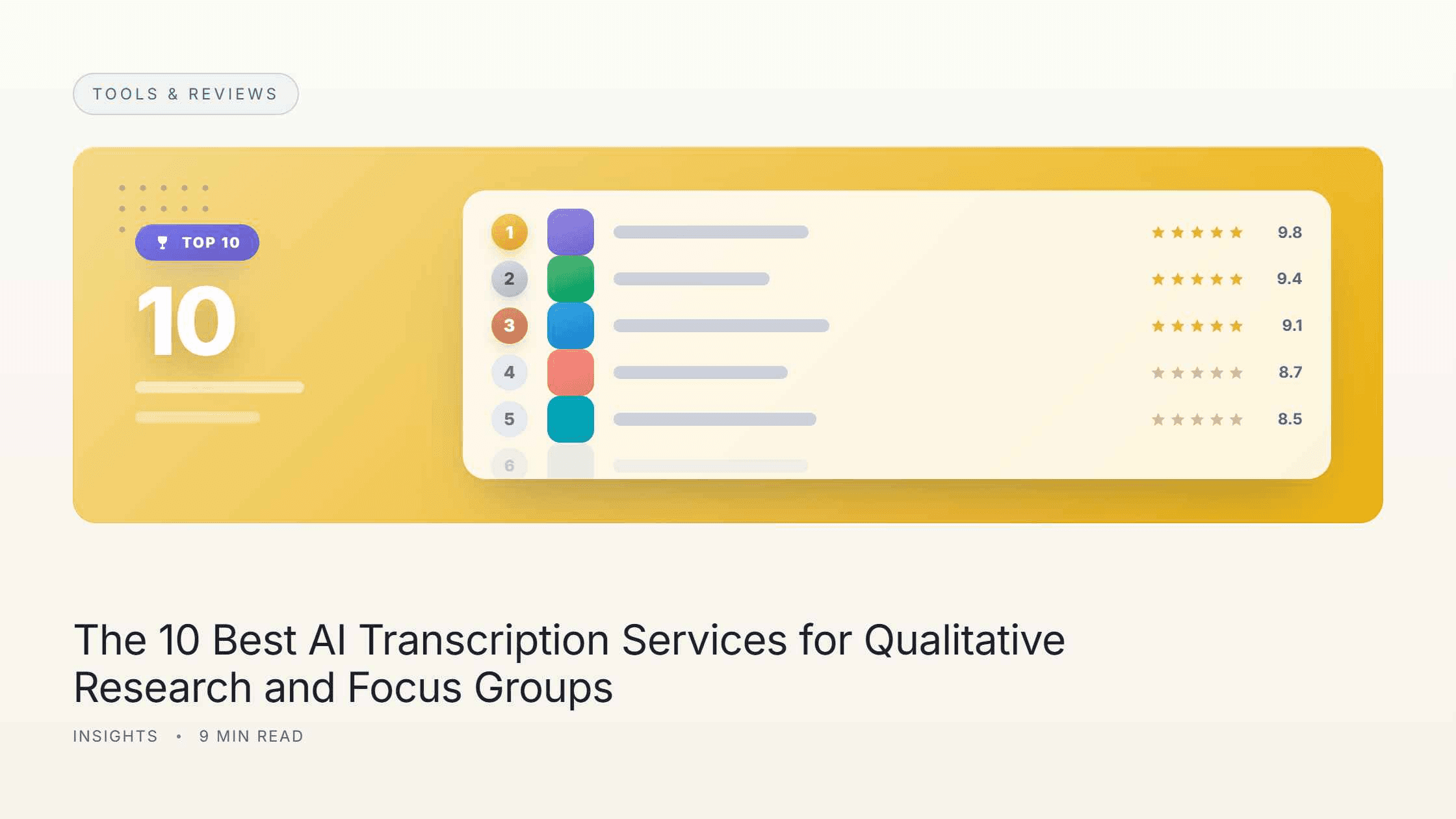
The 10 Best AI Transcription Services for Qualitative Research and Focus Groups in 2026
Not all AI transcription platforms were designed with research workflows in mind. Multi-speaker focus groups, accented speech, technical terminology, and compliance requirements for IRB-governed studies create demands that most of these tools weren't built around. Some handle it well. Others were built for podcasters and meeting notes, then positioned for research with a compliance badge added later. The criteria that actually matter for research: how well the AI handles multiple speakers, whether it supports analysis workflows beyond the transcript itself, what it does with your recordings, and whether it meets the compliance frameworks that IRB boards and ethics committees require.
Read article
© 2026 Qualtranscribe LLC. Services Provided Globally